
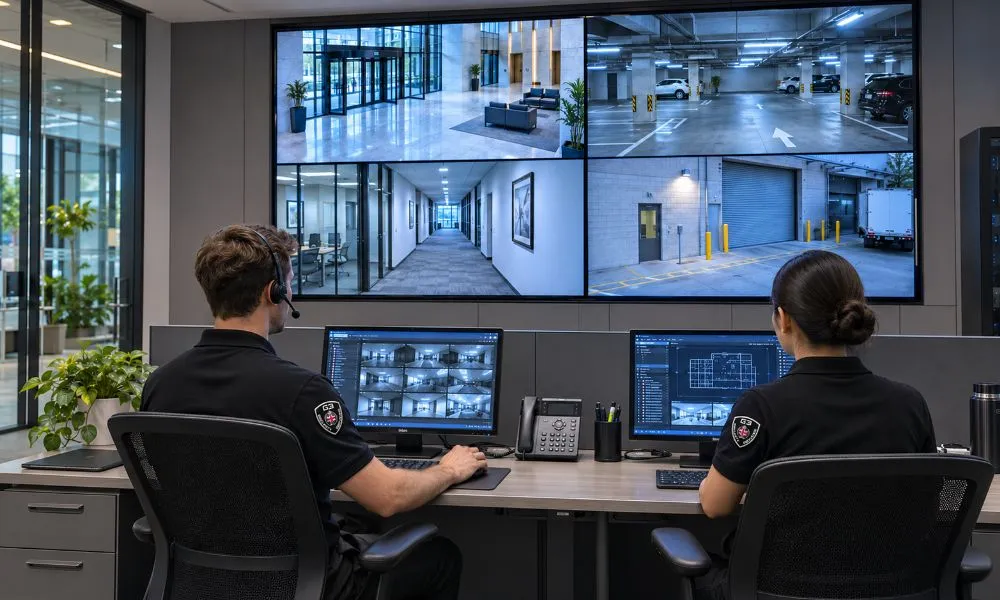
Most businesses cannot keep security guards at every site, every hour of the day. A 24 hour security control room fills that gap, giving you constant protection, fast response to incidents and a clear record of everything that happens, without placing staff at every location.
In this guide, we explain what a control room does, how operators handle alarms, the people and technology behind it, the UK standards that matter and how to choose the right monitoring provider for your site.
What is a 24 Hour Security Control Room?
A 24 hour security control room is a secure, permanently staffed centre where trained operators watch over one or many sites at once. It brings all of a site’s security systems and security staff together in one place, so that every alert is seen, checked and acted on, day or night. You may also hear these related terms:
- Alarm Receiving Centre (ARC): A monitoring centre that receives signals from intruder alarms, hold-up alarms, fire alarms and lone worker devices, and passes confirmed alarms to the police or keyholders.
- Remote Video Response Centre (RVRC): A centre that monitors CCTV remotely, often triggered by detectors on site, and can speak to intruders through loudspeakers.
- On-site Control Room: A control room inside a large building or campus, such as a shopping centre, hospital or stadium, run by the site’s own security team.
A professional security company combines all of these roles in one 24/7 control room, so a single team handles alarms, CCTV, security officers and lone workers together.
What Does a 24 Hour Security Control Room Do?
A control room is the brain of your security operation. These are its main jobs.
1. Live CCTV Monitoring
Operators watch live camera feeds from your site, either continuously or when a detector is triggered. They look for suspicious behaviour, track people moving across the site and zoom in to confirm what is happening.
2. Alarm Monitoring and Verification
When an intruder, hold-up, fire or panic alarm is activated, the signal goes straight to the control room. Operators check cameras, audio and other detectors to confirm whether the alarm is real before calling anyone out. This cuts wasted call-outs and makes sure real incidents get a fast response.
3. Access Control Monitoring
The control room can watch doors, gates and barriers in real time. Operators can spot forced doors or doors left open, and in many cases can remotely open or lock gates for authorised visitors, contractors and deliveries.
4. Lone Worker Monitoring
Staff who work alone, such as security officers, cleaners, engineers and care workers, can carry a lone worker device or app. If they press an alert button, fall or miss a scheduled check-in, the control room responds immediately, listens in, and sends help or calls the emergency services.
5. Supporting Security Officers
The control room keeps in contact with security guards and mobile patrol officers throughout their shifts. Operators carry out regular welfare checks, track patrols by GPS, confirm that checkpoints have been visited and send officers where they are needed.
6. Keyholding and Alarm Response
When an alarm is confirmed, the control room dispatches a keyholding and alarm response officer to attend the site, check the building, meet the police if needed and secure the premises again. This means you are not woken at night to deal with it yourself.
7. Contacting the Police, Emergency Services and Keyholders
Operators follow agreed instructions for every site. Depending on the incident, they contact the police, fire service or ambulance, and call the named keyholders or managers.
8. Remote Audio Warnings
Many monitored CCTV systems include speakers. When an operator sees an intruder, they can issue a live warning, telling the person they are being watched and that the police are on their way. In many cases, this alone makes intruders leave.
9. Building and Environmental Alerts
Control rooms can also monitor technical alarms such as fire panels, flood sensors, temperature alerts, power failures and lift alarms, so problems are dealt with before they cause serious damage.
10. Incident Logging and Reporting
Every alarm, call and action is recorded with the time and details. Operators save and secure CCTV footage of incidents so it can be used as evidence for the police or insurers, and clients receive regular reports.
How a Control Room Handles an Alarm, Step by Step
Every good control room follows a clear, repeatable process so nothing is missed:
- The Alert Arrives: An alarm, camera detector, lone worker device or access control system sends a signal to the control room.
- The Operator Verifies It: They check live CCTV, listen to audio and look at other detectors to see whether there is a genuine threat.
- They Check the Site Instructions: Every site has an agreed response plan listing who to contact and in what order.
- They Decide on the Response: If it is a false alarm, it is logged and closed. If it is unclear, the operator keeps watching. If it is genuine, they act straight away.
- They Send Help: The operator issues a remote audio warning, dispatches a security officer or keyholder, and contacts the police or emergency services when needed.
- They Record and Report: The incident is logged, footage is saved as evidence, and the client is updated.
This fixed sequence means every incident is handled the same way, quickly and with a full record of what happened.
Who Works in a Security Control Room?
A control room runs around the clock, so it is staffed in shifts by a team of trained professionals:
- Control room operators monitor screens, answer alarms, speak to field staff and follow response procedures.
- Supervisors manage each shift, handle serious incidents and make sure procedures are followed.
- Control room managers oversee staffing, training, quality and client service.
In the UK, CCTV operators who carry out public space surveillance for a security company under contract need a Public Space Surveillance (CCTV) licence from the Security Industry Authority (SIA). The training behind this licence covers the operator’s role, the law around CCTV and data protection, and how to handle evidence properly.
Operators also need calm judgement, clear communication and strong attention to detail. When choosing a provider, it is worth asking how many sites each operator monitors at once, because too many screens per person can slow down responses.
Technology Inside a Modern Control Room
Today’s control rooms combine skilled people with smart technology:
- Video management software and video walls bring hundreds of cameras from different sites onto one screen.
- Alarm management software receives signals, shows each site’s response plan and records every action.
- Video analytics use AI to detect people and vehicles, ignore false triggers such as animals or moving trees, and alert operators only when it matters.
- Two-way audio lets operators warn intruders or speak to staff on site.
- Lone worker apps and devices send alerts, GPS locations and live audio to the control room.
- GPS patrol tracking and digital checkpoints confirm where security officers are and which areas they have checked.
- Remote access control allows operators to open, close and lock doors and gates from the control room.
- Backup power, backup communications and a disaster recovery site keep monitoring running even during a power cut or system failure.
Who Needs 24/7 Control Room Monitoring?
Almost any business or property that cannot be watched in person at all times can benefit. It is especially valuable for:
- Construction sites, where tools, plant and materials are targets for theft after hours
- Warehouses and logistics centres with valuable stock and large perimeters
- Retail stores and shopping centres facing theft and anti-social behaviour
- Offices and multi-site businesses that need one team watching every location
- Vacant and empty properties at risk of break-ins and squatters
- Schools, healthcare sites and public buildings with staff and visitors to protect
- Car dealerships, yards and depots with vehicles and equipment stored outside
- Organisations with lone workers, such as security, care, utilities and maintenance teams
Benefits of 24/7 Control Room Monitoring
- Fast response, day and night. Incidents are spotted and acted on within minutes, even on weekends and bank holidays.
- Crime stopped earlier. Live audio warnings and quick dispatch often stop intruders before damage is done.
- Fewer false alarms. Verification means the police and keyholders are only called out when there is a real threat.
- Lower security costs. One control room can protect many sites for much less than placing security guards at each one.
- Stronger evidence. Logged incidents and saved footage support police investigations and insurance claims.
- Safer staff. Lone workers and security officers always have someone watching out for them.
- One view of every site. Multi-site businesses get consistent security and reporting across their whole estate.
- Insurance compliance. Many insurers expect monitored alarms or CCTV for higher-risk premises.
Control Room Monitoring vs On-Site Security Guards
Both play an important role, and they work best together.
| Comparison Criteria | 24/7 control room monitoring | On-site security guards |
| Coverage | Many sites at once, around the clock | One site, wherever the guard is |
| Presence | Remote, with audio warnings and dispatch | Visible, physical presence on site |
| Response | Verifies and sends help within minutes | Can act immediately on the spot |
| Cost | Lower per site | Higher, especially for 24/7 cover |
| Evidence | Full logs and recorded footage | Officer reports and incident notes |
| Best for | Multi-site estates, out-of-hours and remote sites | High-risk, busy or public-facing sites |
The strongest security plans combine both. Security guards provide a visible deterrent and a physical response on site, while the control room supports them with live CCTV, welfare checks and back-up, and protects every other location when no guard is present.
Conclusion
A 24 hour security control room is the central point of a modern security operation. It watches your CCTV and alarms, verifies every alert, supports security officers and lone workers, and sends the right help at the right time. It also keeps a full record of every incident for the police and insurers.
For businesses that cannot have security guards everywhere at once, a professional, accredited control room provides constant protection, faster response and better value.
 Get a Quote
