
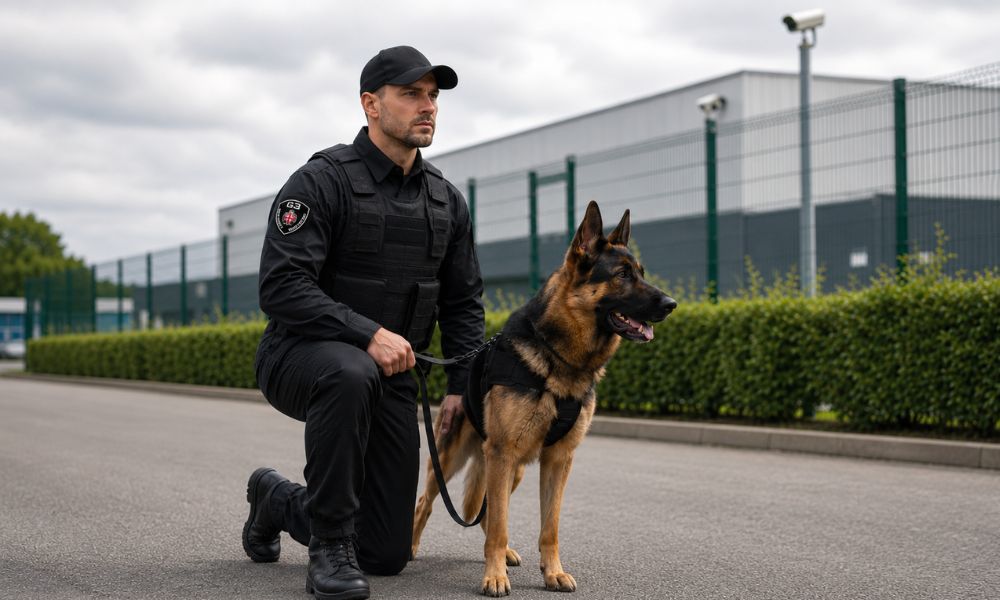
Security dogs provide a visible and highly effective presence in locations where ordinary security measures may not be enough. However, the dog does not work independently. Behind every reliable security dog is a trained handler responsible for controlling the animal, assessing risks, protecting the public, and responding appropriately to incidents.
A security dog handler uses conventional guarding skills with specialist knowledge of canine behaviour. The handler and dog operate as one coordinated unit, often called a K9 team. Together, they may patrol commercial premises, deter trespassers, search buildings, protect valuable assets, or detect specific substances.
The role requires far more than simply walking around a site with a trained dog. Handlers must understand security procedures, maintain complete control of their canine partners, protect the dog’s welfare, communicate with colleagues, and document incidents accurately.
What is a Security Dog Handler?
A security dog handler is a trained security professional who works with a specially prepared dog to protect people, premises, and assets.
The handler directs the dog through verbal commands, hand signals, lead control, and established operational procedures. They must understand how the dog reacts to different environments and recognise subtle changes in its behaviour that may indicate a person, scent, sound, or possible threat nearby.
Although a security dog provides exceptional hearing, scent detection, agility, and deterrence, the handler retains full responsibility for every operational decision. The dog supports the security operation, it does not replace professional judgement.
A competent handler must know:
- When and where the dog may be deployed
- How to maintain control in public and private settings
- How to interpret changes in the dog’s behaviour
- When to withdraw from a developing situation
- How to respond without using unnecessary force
- How to safeguard colleagues, visitors, and members of the public
- How to protect the dog’s physical and emotional welfare
- How to record and report security incidents
Security dog handlers can work for private security companies, public organisations, infrastructure operators, specialist contractors, or other employers with appropriate security requirements.
What are the Main Duties of a Security Dog Handler?
The exact responsibilities depend on the assignment, site risk assessment, dog’s training, and handler’s qualifications. However, most professional security dog handlers perform several core duties.
Conducting Security Patrols
Regular patrols are among the most common responsibilities. A handler and dog may inspect:
- Site entrances and exits
- Perimeter fencing
- Warehouses and storage areas
- Construction zones
- Car parks
- Vacant buildings
- Restricted sections
- Loading bays
- Machinery and equipment areas
During a patrol, the handler looks for open doors, damaged locks, unusual vehicles, signs of forced entry, fire risks, safety hazards, and unauthorised individuals.
The dog may notice movement, scent, or sound before a human officer does. However, the handler must evaluate the behaviour and determine the appropriate response.
Patrol routes should reflect the site’s current risks. Following an entirely predictable pattern can allow offenders to anticipate when particular areas will be unattended.
Deterring Trespassing, Theft, and Vandalism
A trained K9 team creates a strong visual and audible deterrent. The sight of a controlled security dog can prevent an intruder from attempting to enter a protected site.
This deterrent value can be especially useful at:
- Construction sites
- Warehouses
- Industrial premises
- Logistics facilities
- Vacant properties
- Large outdoor compounds
- Infrastructure locations
- High-value storage sites
Deterrence is generally preferable to confrontation. A professional handler aims to prevent an incident or bring it under control safely rather than create an unnecessary physical encounter.
Searching Buildings and Open Areas
When there are signs of unauthorised entry, the handler may be asked to support a controlled search. Depending on the dog’s training, this could involve checking rooms, corridors, storage areas, yards, or sections of a perimeter.
Before beginning, the handler should consider:
- The reason for the search
- The size and layout of the area
- Known hazards
- Whether employees or visitors remain inside
- Available lighting and visibility
- Escape routes
- Communication with the control room
- Whether police assistance is required
The dog’s behaviour may help alert the handler to a concealed person or unusual activity. The handler must maintain control and follow the site’s approved procedures throughout the search.
Responding to Alarms and Security Incidents
K9 teams may respond to alarms, suspicious activity, attempted break-ins, or reports from other security personnel.
The handler’s response may include:
- Assessing the available information
- Approaching the location carefully
- Communicating with the control room or supervisor
- Maintaining a safe distance from the suspected threat
- Issuing clear verbal warnings when appropriate
- Requesting police or emergency assistance
- Protecting people from entering the affected area
- Preserving evidence after the event
- Completing a detailed incident report
The handler should not take unnecessary risks simply because a dog is present. The safety of the public, the handler, colleagues, and the dog remains the priority.
Controlling Access to Restricted Areas
Security dog handlers may help protect entrances, restricted zones, or temporary exclusion areas. Their presence can support access-control procedures during high-risk periods.
The handler may:
- Challenge unauthorised visitors
- Check identification or access permission
- Direct visitors to an authorised entrance
- Prevent entry into unsafe or restricted areas
- Support officers managing a security cordon
- Report repeated access violations
Where members of the public are present, positioning and lead control become especially important.
Conducting Specialist Detection Searches
A qualified detection-dog handler may search vehicles, luggage, buildings, freight, venues, or other defined areas for a trained target scent.
The handler must avoid influencing the dog or treating every behaviour change as a confirmed find. They should understand:
- The dog’s trained indication
- Environmental factors affecting scent
- Search patterns
- Contamination risks
- Rest requirements
- Documentation procedures
- Response procedures following an indication
An indication from a detection dog is handled according to the relevant operational procedure. It is not, by itself, permission for an unqualified handler to undertake actions outside their legal authority.
Maintaining Control of the Dog
Control is one of the handler’s most important responsibilities. The handler must be able to direct, stop, recall, and reposition the dog appropriately.
The UK’s Guard Dogs Act 1975 requires a guard dog used to protect premises to be under the control of a capable handler, except in the specific circumstances permitted by law. The Act also contains requirements concerning warning notices at entrances to guarded premises. Guard Dogs Act 1975
Control involves more than physical strength. It depends on:
- Clear commands
- Consistent handling
- Situational awareness
- A strong working relationship
- Knowledge of the dog’s temperament
- Correct use of equipment
- Recognition of stress and overstimulation
- Sound judgement about when not to deploy
A handler should never use a dog casually to intimidate someone or escalate a manageable situation.
Caring for the Dog’s Welfare
The handler is responsible for the dog as well as the security task. Good welfare supports reliable performance and is a legal and ethical obligation.
The Animal Welfare Act 2006 places a duty of care on people responsible for animals. Relevant needs include a suitable environment and diet, the ability to exhibit normal behaviour, appropriate housing, and protection from pain, injury, suffering, and disease. UK government animal-welfare guidance.
Daily welfare responsibilities may include:
- Supplying clean drinking water
- Providing suitable food
- Checking paws, coat, teeth, and general condition
- Monitoring for pain, illness, or injury
- Providing appropriate rest periods
- Maintaining safe transport and kennelling
- Preventing exposure to extreme temperatures
- Keeping equipment clean and correctly fitted
- Arranging veterinary attention when necessary
- Giving the dog suitable exercise and recovery time
A tired, injured, overheated, or distressed dog should not continue working simply because a shift remains unfinished.
Maintaining Training and Operational Readiness
A security dog’s skills require regular training. Handlers participate in continuation training to maintain obedience, control, search ability, confidence, and task-specific performance.
Training may include:
- Heelwork and lead control
- Recall
- Emergency stops
- Building searches
- Scenario-based patrol work
- Neutrality around people and animals
- Environmental exposure
- Detection exercises
- Vehicle loading and transport
- Safe responses to distractions
Handlers should also maintain relevant records of training, assessments, welfare, and operational deployments where required.
Essential Skills for Security Dog Handlers
Professional dog handling requires a combination of security, communication, practical, and animal-management abilities.
Canine Behaviour Knowledge
Handlers must understand body language, drive, focus, stress signals, fear, fatigue, and changes in behaviour. This enables them to interpret the dog accurately and intervene before a situation becomes unsafe.
Situational Awareness
A handler must monitor the wider environment while also observing the dog. They need to notice escape routes, hazards, unusual behaviour, vulnerable members of the public, and changes that could affect the deployment.
Communication
Clear communication is essential when speaking with colleagues, supervisors, police, clients, visitors, and members of the public. Handlers must give calm instructions and provide accurate information during stressful incidents.
Judgement and Decision-Making
The dog can provide additional information or deterrence, but the handler makes the operational decisions. Good judgement includes knowing when to proceed, pause, withdraw, or request support.
Physical Fitness
The role may involve long patrols, uneven ground, outdoor work, stairs, night shifts, and rapid responses. Handlers need enough fitness and mobility to control the dog safely throughout the assignment.
Patience and Consistency
Dogs learn and perform best under consistent handling. Mixed commands, frustration, or unpredictable treatment can weaken communication and create avoidable risks.
Observation and Record-Keeping
Handlers must detect small environmental changes and document significant events accurately. Strong written records are important for client reporting, investigations, training reviews, and legal accountability.
Emotional Control
A handler must remain composed during confrontations or emergencies. Fear, anger, or panic can affect decisions and influence the dog’s behaviour.
What Qualifications Does a Security Dog Handler Need in the UK?
The exact requirements depend on the work being performed and the employer.
Relevant SIA Licence
The Security Industry Authority does not issue a separate “dog handler licence.” However, a dog handler conducting licensable private-security activity must hold the relevant SIA licence. For example, a person carrying out security guarding would normally need a security-guarding licence, while licensable door-supervision work requires the corresponding licence. Security Industry Authority clarification
Applicants for an SIA licence must generally be at least 18 and meet the applicable identity, qualification, criminal-record, and right-to-work requirements. SIA licence application guidance
Licensing circumstances can vary, including certain in-house roles, so candidates and employers should check the current SIA rules for the actual assignment.
Specialist Dog-Handling Training
Employers commonly look for recognised, role-appropriate dog-handling education. NASDU provides training pathways intended to reflect National Occupational Standards for private-security dog handling, including general-purpose security and specialist detection disciplines. NASDU security-dog training information
It is important to understand that NASDU is an industry membership and standards organisation; the SIA has stated that it does not formally recognise canine associations or self-appointed bodies. A canine qualification should therefore not be described as an SIA dog-handler licence. SIA statement on canine security associations
Employer Assessments and Site Training
A qualification does not remove the need for operational assessment. Employers may also require:
- Handler-and-dog competency assessments
- Site-specific induction
- First-aid training
- Conflict-management training
- Report-writing ability
- Driving eligibility
- Veterinary and vaccination records
- Suitable insurance
- Refresher or continuation training
Both the handler and dog should be suitable for the specific assignment.
Where Do Security Dog Handlers Work?
Security dog handlers can operate across numerous sectors, including:
- Construction sites
- Warehouses and distribution centres
- Industrial premises
- Vacant properties
- Transport and logistics facilities
- Utilities and infrastructure
- Retail environments
- Events and venues
- Corporate sites
- Large residential developments
- Car parks and outdoor compounds
- High-value storage locations
Working conditions may involve nights, weekends, adverse weather, remote areas, and long periods outdoors.
What Does a Typical Shift Look Like?
A shift commonly begins with a briefing and welfare check. The handler reviews incidents from the previous shift, confirms the assignment, checks equipment, and ensures the dog is fit to work.
The handler may then:
- Inspect the site and identify immediate risks.
- Confirm communication procedures and emergency contacts.
- Conduct planned and varied patrols.
- Record observations in the site log.
- Respond to alarms or suspicious activity.
- Give the dog appropriate water and rest breaks.
- Coordinate with other officers or the control room.
- Complete incident reports when required.
- Conduct an end-of-shift welfare and equipment check.
- Deliver a clear handover to the next officer.
No two shifts are identical. A quiet night can change quickly when an alarm, trespass incident, or safety hazard is identified.
Why Security Dog Handlers Matter in 2026
Security operations increasingly combine personnel, CCTV, alarms, analytics, access control, and remote monitoring. K9 teams complement these systems by bringing mobility, scent capability, heightened awareness, and visible deterrence.
Technology can alert a control room to movement, but it may not explain what caused it. A trained handler and dog can help inspect the area, locate signs of intrusion, and provide an immediate physical presence.
Their value is greatest when deployment is based on a proper risk assessment and integrated into the wider security plan.
What Should Businesses Check Before Hiring a K9 Security Team?
Businesses should evaluate more than the appearance of the dog or the hourly rate.
Check:
- The operative’s relevant SIA licence
- Role-specific handler qualifications
- Evidence that the dog is trained for the proposed task
- Current handler-and-dog assessments
- Insurance that covers dog-handling activity
- Welfare, transport, kennelling, and veterinary arrangements
- Incident-reporting procedures
- Continuation-training records
- Site risk assessments and deployment plans
- Contingency arrangements if the handler or dog becomes unavailable
The government advises organisations conducting due diligence on subcontracted dog-handling services to check employee SIA licences, handler qualifications, and appropriate insurance. SIA guidance on dog-handling subcontractors
Final Thoughts
A security dog handler is responsible for much more than controlling a dog during patrols. The role combines professional security work, risk assessment, canine behaviour, incident response, public safety, legal compliance, and animal welfare.
The dog may provide exceptional senses and a strong deterrent presence, but the handler provides judgement, direction, and accountability. An effective K9 team is built through appropriate selection, recognised training, regular assessment, consistent handling, and a relationship based on control and trust.
For businesses, choosing a competent handler-and-dog team can strengthen an existing security strategy. For individuals considering the career, it is a demanding role that requires patience, discipline, physical readiness, and a genuine commitment to both public protection and canine welfare.