
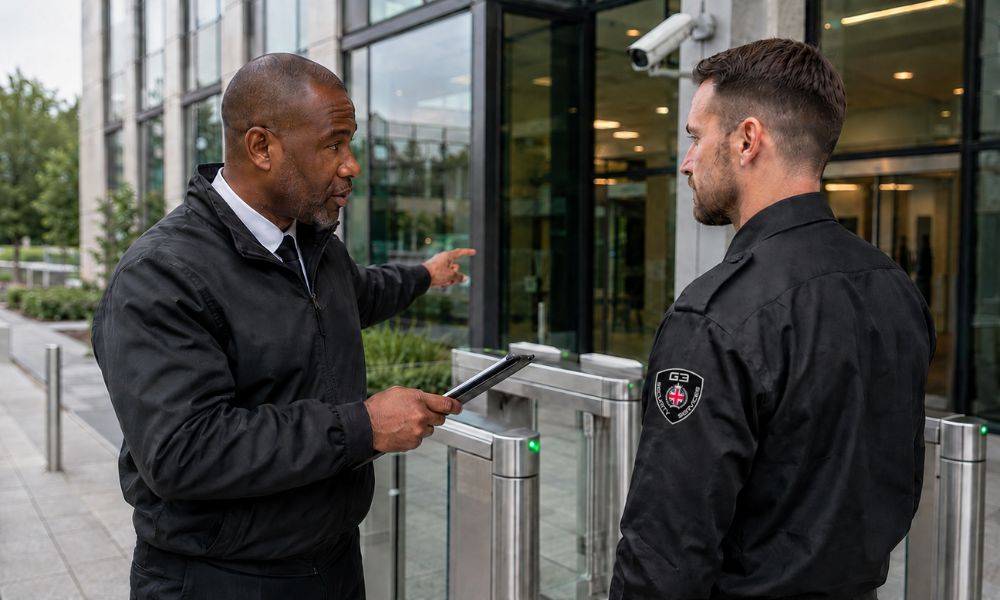
Security officers play an important role in protecting employees, visitors, property, equipment, and confidential information. When an officer repeatedly misses patrols, arrives late, submits incomplete reports, or fails to remain alert, the reliability of the entire security operation may decline.
However, poor security guard performance does not always mean that the individual is irresponsible or unsuitable. Inadequate training, unclear instructions, unrealistic workloads, fatigue, weak supervision, and unsuitable role placement can all contribute to the problem. Businesses should therefore investigate the cause, document their concerns, and provide appropriate support before deciding what further action is necessary.
This guide explains how businesses can identify, address, and prevent poor security guard performance through a fair and structured process.
What Does Good Security Guard Performance Look Like?
Before assessing an officer, a business must clearly define what good performance means for that particular assignment. Expectations should be based on written duties, property-specific risks, operating procedures, and agreed service levels.
A professional security officer should normally:
- Arrive on time and complete a proper handover
- Remain alert throughout the shift
- Follow assignment instructions
- Complete patrols at the required times
- Monitor entrances and restricted areas
- Communicate professionally with employees and visitors
- Record incidents accurately
- Respond appropriately to emergencies
- Maintain professional conduct and appearance
Requirements will vary between assignments. A corporate reception officer may require strong visitor-management and communication skills, whereas an officer at a warehouse may focus more heavily on perimeter patrols, vehicle movements, and access control.
Performance should therefore be measured against the actual requirements of the role rather than vague personal impressions.
What are the Signs of Poor Security Guard Performance?
Underperformance should be identified through observable actions, records, and recurring patterns. One single mistake does not necessarily indicate a serious performance problem, particularly if the officer was dealing with unusual circumstances.
Common warning signs include:
- Repeated late arrival for shifts or handovers
- Missed or incomplete patrols
- Sleeping or using a phone while on duty
- Poor attention at entrances or CCTV stations
- Inaccurate or delayed incident reports
- Failure to follow assignment instructions
- Unprofessional communication
- Leaving the assigned post without permission
- Unsuitable responses to incidents
- Failure to report suspicious activity
- Declining standards of appearance or conduct
Managers should distinguish between a single error and an ongoing pattern. Patrol records, incident reports, attendance data, CCTV footage, and supervisor notes can help establish whether the concern is recurring.
How Can Poor Guard Performance Affect a Business?
An underperforming officer can create security gaps before a major incident takes place. Missed patrols may leave vulnerable areas unmonitored, while weak access control can allow unauthorised individuals to enter the property.
Poor performance may expose a business to:
- Theft and property damage
- Unauthorised access
- Trespassing and vandalism
- Delayed emergency responses
- Incomplete incident evidence
- Health and safety concerns
- Employee and visitor complaints
- Reputational damage
- Contractual or compliance problems
Poor security performance can affect more than physical safety. Employees may feel less secure, visitors may develop a negative impression of the business, and incomplete reports can make incidents difficult to investigate.
Why Do Security Guards Underperform?
Businesses should identify the reason for poor performance before assuming that the officer is not committed to the role. The same performance issue can have several different causes.
Poor Recruitment and Unsuitable Role Placement
An officer may hold the appropriate licence but still be unsuitable for a particular assignment. Some positions require strong customer-service and report-writing skills, while others depend on physical patrols, lone working, or disciplined access control.
Security providers should assess each officer’s experience, communication skills, behaviour, and practical abilities before assigning them to a property.
Inadequate Property-Specific Training
Officers cannot perform consistently if they have not been properly introduced to the property. Rushed training may leave officers unsure about patrol routes, emergency exits, alarm systems, restricted areas, and reporting procedures.
Every officer, including temporary replacements, should complete a property-specific training before working independently.
Poorly Defined Duties and Procedures
Work instructions should clearly explain each officer’s duties, when they must be completed, and who to contact if a problem occurs. Unclear, outdated, or conflicting instructions can result in missed tasks and inconsistent responses.
Procedures should be reviewed whenever the property, operating hours, staffing arrangements, or security risks change.
Insufficient Professional Training
An SIA licence confirms that an officer is qualified to perform specific security duties. However, officers still need property-specific preparation and regular training. Performance may suffer if they lack the skills or confidence to manage incidents, emergencies, conflict, customer interactions, first aid, or security technology.
Unmanageable Duties
A missed patrol does not always mean that an officer has neglected their duties. The patrol route may be too long, the officer may have several tasks to manage, or they may be unable to leave an access-control point.
Managers should ensure that officers can complete their assigned duties within the available time and staffing levels.
Difficult Working Conditions
Long shifts, changing schedules, night work, limited breaks, and frequent overtime can reduce an officer’s focus and ability to make sound decisions. Officers working alone may also feel isolated and have limited access to support.
A well-planned work schedule should give officers enough rest while ensuring sufficient trained staff are available for every shift.
Lack of Proper Supervision
Small issues can become recurring problems when officers receive limited management support. Regular property visits, report reviews, spot checks, and performance discussions help maintain standards and identify concerns early.
How Should Businesses Record Performance Issues?
Accurate documentation creates a fair record and helps the business separate facts from assumptions. It also gives the officer and security provider a clear understanding of the issue.
- Date, time, and location of the issue
- Duty missed or completed incorrectly
- Expected performance standard
- Relevant work instructions
- Evidence supporting the concern
- Effect on security or operations
- Officer’s explanation
- Immediate action taken
- Name of the person reporting the issue
Descriptions should focus on facts rather than personal opinions. Instead of calling an officer “lazy,” record the specific duties they failed to complete. For example, note that the officer missed two scheduled patrols, did not update the daily log, and gave no explanation during the shift handover.
The record should also include any guidance, training, equipment, or additional supervision provided to help the officer improve.
Who Should Be Informed About the Problem?
The reporting process depends on whether the officer is employed directly by the business or provided by an external security company.
Minor concerns can first be discussed with the officer or shift supervisor. Repeated or serious problems should be reported to the contract manager or the security company’s main contact.
The usual reporting route is:
- Officer or shift supervisor
- Property or facilities manager
- Security contract manager
- Security company’s operations team
- Human resources, if formal action is required
An immediate response may be necessary if the issue creates a serious safety or security risk. In other situations, the client should report the concern to the security provider and allow the officer’s employer to follow its formal procedures.
What is a Performance Improvement Plan?
A performance improvement plan explains what the officer needs to improve, what support they will receive, and when their progress will be reviewed. It provides clear and measurable targets instead of simply telling the officer to “perform better.”
The plan may require the officer to:
- Arrive on time for every shift
- Complete all scheduled patrols
- Submit accurate reports on time
- Follow access-control procedures
- Attend refresher training
- Complete supervised shifts
- Communicate professionally with visitors
- Follow shift-handover procedures
Each target should be realistic and relevant to the officer’s role. The plan should also state who will monitor progress, when the review will take place, and what action may follow if the required standard is not achieved.
How Does Ongoing Training Improve Performance?
Training should continue after recruitment and initial licensing because security risks, technology, legal requirements, and client operations can change over time.
Regular training may cover:
- Access control
- Conflict management
- Emergency response
- First aid
- Fire safety and evacuation
- Incident reporting
- Customer service
- CCTV operation
- Radio communication
- Data protection
- Property-specific security risks
Ongoing training helps officers build confidence, follow procedures correctly, and avoid preventable mistakes. It also shows that the security provider values professional development.
Managers should maintain training records to track completed courses and identify areas where an officer may need further support.
Which Performance Measures Should Businesses Monitor?
Businesses should agree on measurable performance measures with their security provider. These standards help businesses review security services fairly and identify recurring performance issues.
Useful performance measures include:
- Shift attendance
- On-time arrival
- Completed patrols
- Incident-response times
- Report accuracy and timely submission
- Compliance with access-control procedures
- Training completion
- Supervisor inspection results
- Client complaints
- Positive client feedback
- Completion of corrective actions
- Staff turnover
Performance data should be reviewed regularly, not only when a complaint occurs. Regular reviews help maintain accountability, identify training needs, and improve the overall security service.
When is Formal Action Required?
Formal action may be necessary when feedback, training, and additional support have not improved the officer’s performance. Immediate action may also be required if the officer’s conduct creates a serious safety or security risk.
Examples include:
- Repeatedly failing to complete essential duties
- Intentionally ignoring work instructions
- Providing false patrol or incident records
- Sleeping while responsible for an important post
- Leaving the property without permission
- Committing serious misconduct
- Failing to meet licensing or compliance requirements
- Putting people or property at risk
The security provider should follow its employment policies and contractual procedures. The review should consider records of previous discussions, training, support, and performance improvement plans.
Formal action should be handled fairly and professionally as an employment matter, not as a personal disagreement.
How Does a Security Company Maintain Officer Performance?
At G3 Security, we understand that dependable protection requires more than placing an officer at a property. Performance depends on selecting suitable personnel, providing clear instructions, supporting them properly, and reviewing standards throughout the assignment.
As your security company, G3 Security can assess your property, identify its risks, and develop clear duties around your operating requirements. Our approach includes assignment-specific induction, structured supervision, performance monitoring, professional reporting, and communication with client management.
When concerns arise, we examine both the officer’s performance and the wider operating environment. This helps us determine whether the appropriate response involves clearer instructions, refresher training, additional supervision, reassignment, or replacement.
Conclusion
Businesses can improve poor security guard performance by identifying problems early, documenting specific evidence, investigating the underlying cause, and providing targeted support. Clear instructions, realistic duties, continuous training, dependable supervision, and measurable performance standards all contribute to a stronger service.
Underperformance should not be ignored, but immediate replacement is not always the best solution. A fair and structured process can often reveal whether the problem relates to training, communication, workload, role suitability, or wider provider management.
G3 Security provides professionally managed security services focused on consistent officer performance and reliable protection. Contact G3 Security to discuss your requirements and arrange a tailored assessment of your current security arrangements.