
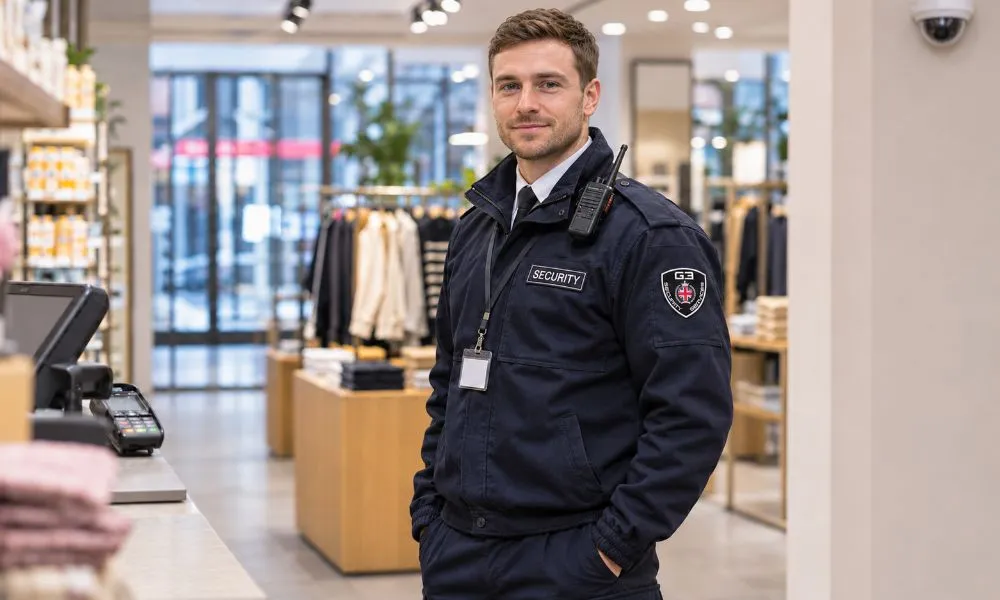
Shoplifting and violence against shop workers remain among the biggest challenges facing UK retailers. According to the British Retail Consortium’s 2026 Crime Report, retailers detected 5.5 million incidents of shoplifting in the past year, costing nearly £400 million. Shop workers also faced around 1,600 incidents of violence and abuse every day.
A professional security guard is one of the most effective ways to protect your store, staff and customers. But a guard who oversteps the law can create a new set of problems, from complaints and bad publicity to legal claims against your business.
This guide explains what retail security guards can and cannot legally do in the UK, how citizen’s arrest really works, and how to make sure your security team stays on the right side of the law.
Why Retail Security Matters More Than Ever in 2026
Retail crime is no longer just about the odd shoplifter. Today, stores deal with organised gangs, repeat offenders and thieves who are ready to threaten or attack staff.
Violence and abuse against shop workers has dropped from around 2,000 incidents a day in 2023/24 to 1,600 a day. That is still one of the highest levels on record. And because many thefts are never spotted, the real cost to retailers is likely to be even higher.
The law is changing as well. The Crime and Policing Act 2026 makes assaulting a retail worker a specific criminal offence, and retailers want these new rules to take effect as soon as possible.
As a result, more retailers are hiring professional security guards. That makes it more important than ever to know exactly what those guards are allowed to do.
Why Retailers Must Understand the Legal Boundaries
Knowing the legal limits of security work is not just a matter for guards. It matters to every retailer who hires them.
- Legal Liability: If a guard wrongly detains, searches or injures a customer, the retailer can be held responsible alongside the guard and the security company.
- Reputation: A single video of a heavy-handed guard can spread on social media within hours and damage customer trust for years.
- Customer Confidence: Shoppers feel safer when security is professional, calm and respectful, not aggressive or intimidating.
- Staff Safety: Guards who follow clear legal procedures are less likely to escalate a situation and put themselves or your staff at risk.
In short, a guard who knows the law protects your business twice: once from criminals, and once from costly mistakes.
The Legal Framework: Which UK Laws Apply?
There is no single “security guard law” in the UK. Instead, a guard’s powers and limits come from several different laws. These are the main ones every retailer should know about (this guide focuses on England and Wales).
| Law | What it means for retail security |
| Private Security Industry Act 2001 | Created the Security Industry Authority (SIA) and the licensing system for contract security staff |
| Police and Criminal Evidence Act 1984, section 24A | Sets out when “any person”, including a guard, can make a citizen’s arrest |
| Criminal Law Act 1967, section 3 | Allows only reasonable force to prevent crime or make a lawful arrest |
| Human Rights Act 1998 | Protects people’s liberty, dignity and privacy |
| UK GDPR and Data Protection Act 2018 | Controls how CCTV and body-worn camera footage is recorded, stored and shared |
| Equality Act 2010 | Prohibits treating customers differently because of race, religion, disability or other protected characteristics |
| Crime and Policing Act 2026 | Introduces a specific offence of assaulting a retail worker |
Together, these laws draw a clear line: guards can protect property and people, but they must respect the rights of everyone in the store, including suspected shoplifters.
Do Retail Security Guards Have Special Legal Powers?
No. This is the most important point in this entire guide. Retail security guards, door staff and shop employees have no special arrest powers of their own. They have exactly the same legal powers as any other member of the public.
A uniform, a badge or an SIA licence does not give a guard the authority of a police officer. What the licence does show is that the guard has passed identity and criminal record checks and completed approved training, including how to handle conflict and when an arrest is lawful.
Do In-House Retail Guards Need an SIA Licence?
SIA licensing mainly applies to contract security, where a security company supplies guards to a retailer. Guards employed directly by the retailer (in-house) are often not legally required to hold a licence. Even so, many retailers insist on it, because licensed guards are vetted and trained to a recognised standard. If you are unsure, check the latest rules on the SIA website.
What Retail Security Guards Can Legally Do
Although their powers are limited, retail guards can do a great deal to protect a store. Most of their value comes from prevention rather than confrontation.
Deter Theft Through a Visible Presence
A uniformed guard at the entrance is one of the strongest deterrents to shoplifting. Guards can patrol the shop floor, stand near high-value displays and greet customers as they arrive. A friendly “hello” lets people know they have been noticed, which is often enough to put off an opportunist thief.
Monitor CCTV and Use Body-Worn Cameras
Guards can watch CCTV and wear body-worn cameras to record incidents. All footage must be handled in line with UK GDPR. That means clear signs telling people recording is taking place, secure storage, and sharing footage only for legitimate reasons, such as with the police.
Refuse Entry or Ask Someone to Leave
A shop is private property. Acting on behalf of the retailer, a guard can refuse entry to someone or ask them to leave. If the person refuses, they become a trespasser, and the guard can use reasonable force to remove them, although calling the police is usually the safer option.
Observe and Report Suspicious Behaviour
Guards can watch customers whose behaviour raises concern and share information with store staff and management. The key is to observe, not accuse.
Gather and Preserve Evidence
Guards can write incident reports, note descriptions, secure CCTV footage and record witness details. Good evidence makes it far more likely that the police and courts can act.
Respond to Emergencies
Guards are often the first to respond to fires, medical emergencies and disturbances, and they play a key role in keeping people safe until the emergency services arrive.
Can Security Guards Arrest Shoplifters?
Yes, but only in limited situations. Security guards have the same power of arrest as any member of the public. This is known as a citizen’s arrest, under section 24A of the Police and Criminal Evidence Act 1984. A guard can make a citizen’s arrest only when:
- they saw the person commit an offence such as theft, or have good reason to believe they did
- the arrest is needed, for example to stop the person running off or hurting someone
- a police officer is not able to make the arrest instead
A guard cannot arrest someone who is only about to commit an offence. After an arrest, the guard should call the police straight away, keep everyone safe and hand the person over when the police arrive.
Why Restraint Training Saves Lives
Physical restraint carries real dangers. Holding someone face down or applying pressure to their chest or neck can restrict breathing and has led to serious injury and death. Guards who may need to restrain people should be trained in safe techniques and know when to let go.
Always Try to Calm Things Down First
The best guards rarely need to use force at all. Calm communication, keeping a safe distance and giving the person a way out of the situation are usually far more effective, and far safer, than physical intervention.
How Can Retail Security Guards Legally Manage Emergencies?
Security guards are often the first point of contact when something goes wrong in a store. Their role in an emergency is to keep people safe until the emergency services take over.
What Guards Can Do in an Emergency
- Evacuate the Premises: Guide customers and staff to the nearest safe exit during a fire or other threat.
- Manage Crowds: Give clear, calm directions to prevent panic and crushing.
- Provide First Aid: Give first aid within the limits of their training while waiting for an ambulance.
- Secure the Area: Keep people away from the scene and preserve any evidence.
Working With the Emergency Services
When the police, ambulance or fire service arrive, the guard should give a short, clear briefing, what happened, where, who is involved and what action has already been taken. After that, the guard follows their instructions and supports them in keeping the area safe.
What Retail Security Guards Cannot Legally Do
This table sums up the key legal limits.
| Action | Can a guard do it? |
| Patrol the store and deter theft | Yes |
| Ask someone to leave the store | Yes |
| Make a citizen’s arrest for theft under PACE section 24A | Yes, if the strict conditions are met |
| Arrest someone on a hunch or before an offence is committed | No |
| Search a customer or their bag without consent | No |
| Use reasonable force to make a lawful arrest or prevent crime | Yes |
| Use excessive force or punish a suspect | No |
| Demand a customer’s ID or personal details | No |
| Carry weapons such as batons or sprays | No |
| Pretend to be a police officer | No |
| Target customers based on race, religion or appearance | No |
How to Choose a Legally Compliant Retail Security Provider
The quality of your security provider decides how well your guards understand and follow the law. Before signing a contract, check that your provider offers:
- SIA-Licensed Guards: Every guard should hold a valid SIA licence, which you can check on the public SIA register.
- Approved Contractor Status: SIA Approved Contractor Scheme (ACS) membership shows the company meets recognised quality standards.
- Proper Training: Guards should be trained in citizen’s arrest, conflict management, safe restraint and first aid.
- Body-Worn Cameras and Clear Reporting: Good providers record incidents and give you detailed reports.
- GDPR-Compliant Procedures: Footage and personal data must be handled lawfully.
- Public Liability Insurance: This protects your business if something goes wrong.
- Retail Experience: Guards who know retail understand how to balance security with customer service.
- Local Knowledge: A provider that knows your area can build links with local police and other retailers.
At G3 Security, we have been protecting businesses across London and the UK. Our SIA-licensed retail security guards are trained to deter theft, handle difficult situations calmly and always act within the law. We work closely with store managers to understand each site’s risks, and we provide clear incident reporting so you always know what is happening in your store. Whether you need a single guard for a busy weekend or a full security team all year round, G3 Security delivers reliable, professional protection that keeps your staff, customers and stock safe.
Conclusion
Retail security guards help protect stores, staff and customers by staying visible, spotting problems early and responding calmly. When an incident occurs, guards should understand the legal limits on searches, arrests and the use of force, and know when to involve the police.
Choosing a trained, licensed and experienced security team helps reduce theft and protect your business from costly mistakes. Look for a provider whose guards can explain how they handle suspected theft and follow your store’s procedures in practice.
 Get a Quote
