
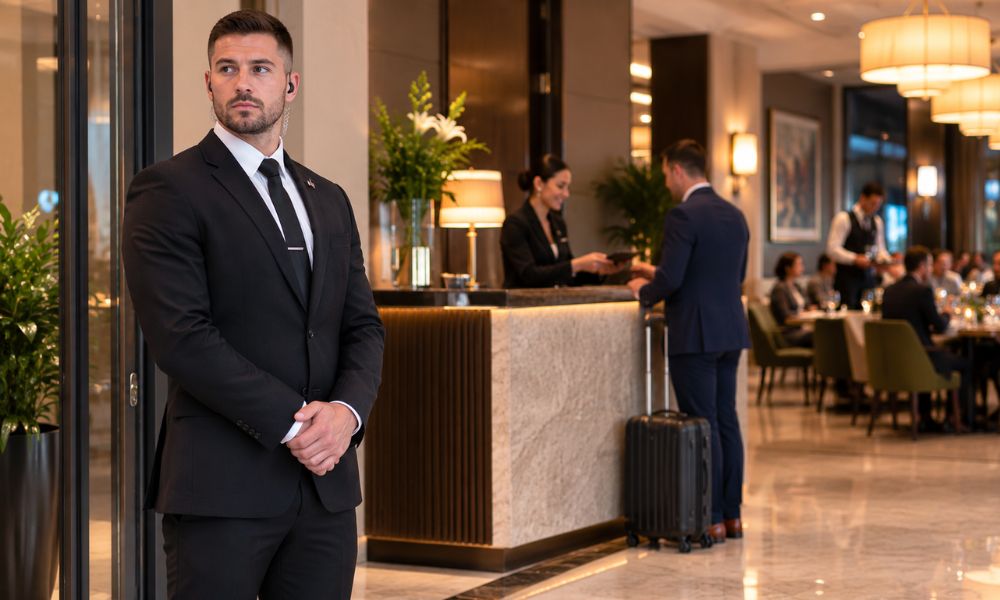
Hotels and restaurants welcome a continuous flow of guests, employees, clients, and delivery personnel. This open environment supports good hospitality, but it can also expose a venue to theft, disorder, unauthorised access, aggressive behaviour, and other security risks.
A professional hospitality security service helps protect guests, employees, property, and business operations without making the venue feel unwelcoming. Depending on the venue, the service may include door supervision, access control, security patrols, CCTV monitoring, conflict management, key holding, and emergency response.
What is a Hospitality Security Service?
A hospitality security service provides trained personnel and organised procedures to protect hotels, restaurants, bars, and similar businesses.
Hospitality officers perform many conventional security duties, but they must also understand the importance of customer service. Their behaviour affects how guests perceive the venue, so they must remain professional, approachable, and discreet.
The service may cover entrances, reception areas, guest corridors, car parks, kitchens, storage rooms, loading areas, and other restricted locations. Before deployment, the provider should assess the area and create clear instructions covering duties, patrol routes, access rules, reporting, and emergency procedures.
What Does Hospitality Security Cover?
The exact service should be adapted to the venue rather than sold as a standard package. The following duties are commonly included in hotel and restaurant security arrangements.
Door Supervision and Access Control
Door supervisors manage entrances and help ensure that only authorised people enter the property or restricted areas. Their duties may include checking identification, applying age restrictions, managing guest queues, implementing venue policies, and refusing entry when appropriate.
Within a hotel, access control can also cover staff entrances, service corridors, plant rooms, storage areas, and private functions. Professional officers apply access rules calmly and consistently. They should protect the establishment without creating an unnecessarily confrontational atmosphere.
Security Patrols and CCTV Monitoring
Security patrols help identify open doors, damaged locks, suspicious individuals, safety hazards, and signs of theft or forced entry.
In hotels, patrol routes may include lobbies, corridors, stairwells, car parks, and external boundaries. Restaurant patrols may concentrate on entrances, toilets, outdoor dining spaces, stockrooms, and closing areas.
CCTV can support these patrols by providing wider coverage and recorded evidence. However, cameras cannot physically respond to a threat. Effective protection requires trained personnel, clear monitoring responsibilities, and an agreed procedure for responding to suspicious activity.
Businesses using CCTV must comply with UK data-protection requirements. The Information Commissioner’s Office states that organisations must identify and document a lawful basis for processing personal information through surveillance systems. Footage should also be retained only for as long as it is genuinely required.
Conflict Management and Incident Response
Security officers may need to deal with aggressive guests, intoxicated customers, staff disputes, suspicious behaviour, or other disturbances.
A trained officer should attempt to resolve conflict through calm communication and conflict-management techniques. The objective is to prevent the situation from becoming more serious while protecting guests and employees.
When an incident occurs, the officer may separate the people involved, establish a safe area, contact management, request police or medical assistance, save relevant evidence, and complete a written report.
The response procedure should be agreed in advance so everyone knows who makes decisions and when an incident must be passed to senior management or emergency services.
Theft and Property Protection
Hospitality venues contain valuable equipment, cash, stock, personal belongings, and customer information. These assets may attract opportunistic or organised theft.
Hotel security officers help protect them by monitoring entrances, controlling restricted areas, conducting patrols, and investigating suspicious activity. They may also support the protection of cash-handling areas, luggage rooms, loading bays, and delivery entrances.
Security cannot remove every possibility of theft, but visible supervision and consistent controls can reduce opportunities and improve the quality of evidence when an incident occurs.
Key Holding and Alarm Response
A security provider may hold a set of keys or another access device for emergency and out-of-hours use. When an alarm is activated, an authorised officer can attend the property, inspect the location, and determine what action is required.
The officer may contact the police, fire service, maintenance team, or venue management, depending on the situation. They may also secure a damaged door or remain at the property until responsibility is transferred.
Key-holding responsibilities must be written clearly into the contract. It should explain who may access the keys, how they are stored, which alarms are covered, and when management must be contacted.
Event and Late-Night Security
Weddings, conferences, private dinners, and entertainment events can significantly change a venue’s normal risk profile. More visitors may be present, unfamiliar people may enter restricted areas, and alcohol service may continue later than usual.
Event security can include guest-list checks, queue management, entrance supervision, patrols, emergency-exit monitoring, and support for venue staff.
Late-night security may also protect employees as they close tills, secure the building, or walk to their vehicles. These responsibilities should be stated separately rather than assumed to be part of an ordinary guarding shift.
Hotel Security vs Restaurant Security
Hotel and restaurant security share several duties, but their operational priorities are different. Hotel security often covers a larger property operating continuously. Officers may monitor reception areas, guest floors, lifts, car parks, service entrances, and private functions. Overnight protection is particularly important because fewer managers may be available to respond to disturbances or emergencies.
Restaurant security usually concentrates on entrances, queues, customer behaviour, alcohol-related incidents, payment disputes, and closing procedures. The busiest and highest-risk periods often occur during evenings and weekends.
The best security plan reflects how the venue operates. A hotel with several event spaces requires a different arrangement from a small restaurant that only needs additional supervision during late-night trading.
How to Choose a Hospitality Security Provider
G3 Security assessing your property rather than recommending a standard package based solely on its size.
Our security team can inspect entrances, public areas, service routes, operating hours, closing procedures, and event schedules to understand your specific requirements. We then prepare a clear proposal outlining the services included, the number of officers required, their relevant licences, and the procedures for recording and reporting incidents.
Your security agreement should clearly define:
- Patrol routes and frequency
- Access-control responsibilities
- Management contact procedures
- CCTV-monitoring duties
- Alarm-response arrangements
- Event-security requirements
- Shift handover procedures
- Incident-reporting standards
- Officer replacement arrangements
- Service-review schedules
Although price is important, it should not be the only factor guiding your decision. A low-cost service with poorly defined responsibilities may leave serious security gaps during busy periods or emergencies. At G3 Security, we provide a tailored hospitality security service designed around your property, operating schedule, and potential risks.
Final Thoughts
A professional hospitality security service covers much more than placing a guard at the entrance. It can include door supervision, access control, patrols, CCTV monitoring, conflict management, theft prevention, key holding, alarm response, and event security.
The right arrangement should reflect the venue’s actual risks and trading pattern. Hotels may require continuous coverage across guest and service areas, while restaurants often need additional support around entrances, alcohol service, and late-night closing.
Before hiring a provider, confirm that every responsibility is documented and assigned to appropriately licensed personnel. Clear expectations, trained officers, and reliable reporting allow security to protect the business while preserving the welcoming experience guests expect.