
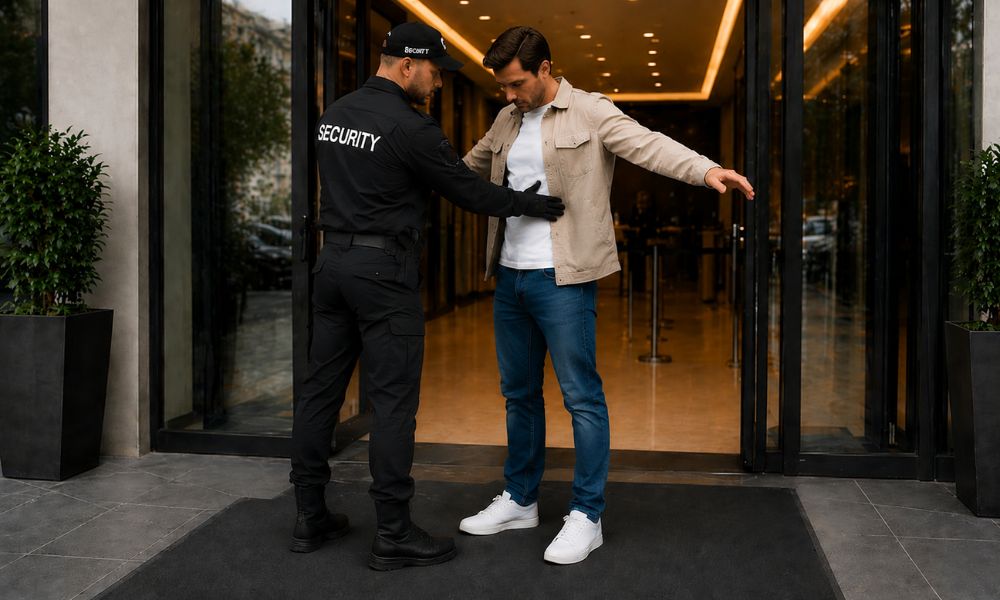
Security guards are licensed professionals responsible for a range of duties, including patrolling premises, monitoring entrances and exits, protecting property, and helping to prevent crime. In some situations, they may need to use physical intervention during a security incident or breach. But can security guards legally touch someone in the UK?
The short answer is yes. Security guards in the UK are permitted to use reasonable physical force, but only in specific circumstances and within the limits of the law. Any contact must be necessary, proportionate, and justified.
The three main situations where physical contact may be lawful include:
- Carrying out a lawful search with your consent or where legal authority allows it.
- Preventing harm or protecting safety when there is an immediate threat or risk to people or property.
- Detaining or restraining an individual when there are reasonable grounds to believe they have committed, or are about to commit, an offence, until the police arrive.
Can a Security Guard Legally Touch You?
Security guards may only touch or restrain someone when there is a lawful and justified reason, such as preventing crime or protecting safety. Any force used must be reasonable, proportionate, and not excessive.
A Security Guard Can Only Touch You if it is Legally Justified
A security guard may only use physical contact when there is a lawful reason to do so. This can include preventing a crime, protecting someone’s safety, stopping damage to property, or carrying out a lawful citizen’s arrest where permitted by law.
They Cannot Use Excessive Force or Touch You Without a Valid Reason
Security guard services do not have unlimited powers. Any force used must be reasonable and proportionate to the situation. If a guard uses unnecessary force or touches someone without legal justification, it may be considered assault or unlawful conduct.
You Have the Right to Ask Why You Are Being Stopped or Touched
If a security guard stops or physically restrains you, you are entitled to ask why the action is being taken. If you believe the force used was unnecessary or inappropriate, you can request that the incident be recorded, reported, or reviewed through the relevant authorities or company management.
When is a Security Guard Allowed to Use Physical Contact?
A security guard should only use physical contact when it is necessary, lawful, and carried out with care. In the UK, any force used must remain within reasonable limits and be justified by the situation.
Several key principles determine when physical contact may be permitted:
- Proportionate Force: Any physical contact must be suitable for the circumstances, with only the minimum level of force used to resolve the issue safely.
- Reasonable Action: Contact must be reasonable in order to maintain security, prevent harm, protect property, or enforce lawful rules. Excessive force is not acceptable.
- Legal Justification: A security guard may use physical contact where lawful authority exists, such as carrying out a search with consent or acting under specific legal powers.
- Professional Behaviour: Guards must act professionally at all times and treat people fairly and respectfully. Harassment, intimidation, or unlawful physical contact is not permitted.
In What Circumstances Can a Security Guard Use Force?
Security guards may only use physical force in specific, legally justified situations. Any force used must always be reasonable, necessary, and proportionate to the circumstances. Below are the main situations where the use of force may be permitted.
Self-Defence
Security guards are allowed to use reasonable force to protect themselves if they are faced with an immediate threat or physical attack. The level of force used must only be what is necessary to stop the danger and ensure their own safety.
Defence of Others
A security guard may also intervene to protect another person if they witness someone being threatened or harmed. In such cases, they can use reasonable force to prevent injury or stop the attack, provided their actions are proportionate to the situation.
Preventing a Crime
Force may be used if a security guard reasonably believes that a crime is about to happen or is currently taking place. The purpose of the force must be to prevent the offence, and it must be limited to what is necessary and appropriate under the circumstances.
Detention or Restraint
If a security guard has reasonable grounds to suspect that someone has committed a crime, they may use reasonable force to detain or restrain that individual until the police arrive. For example, in a retail environment, a guard may temporarily detain someone suspected of shoplifting. However, the force used must be minimal and strictly for safe detention only.
Do Security Guards Have Any Legal Power?
Security guards do not hold the same legal authority as police officers and must always operate within the limits of the law. In general, they have no greater powers than an ordinary member of the public. However, because they are employed to protect people, property, and businesses, they are given certain limited responsibilities while on duty.
Within these boundaries, security guards may take reasonable action to prevent crime, protect safety, or respond to incidents. This can include, in specific situations, the use of proportionate physical force when it is legally justified.
What Are the Laws for Security Guards When Using Physical Force?
The actions of security guards in the UK are regulated by several laws and professional standards. These rules ensure that any use of physical force is lawful, justified, and strictly controlled. While guards are not police officers, they must still follow legal guidelines when dealing with incidents.
Criminal Law Act 1967
One of the key legal provisions relevant to security guards is the Criminal Law Act 1967. This law allows a person, including a security guard, to use reasonable force in certain situations such as self-defence or the defence of others. Any force used must be necessary and proportionate to the threat being faced.
Security Industry Authority (SIA) Regulations
The Security Industry Authority (SIA) regulates the private security industry in the UK. Through its licensing and Approved Contractor Scheme (ACS), it sets professional standards for training, behaviour, and conduct. Security guards are required to act lawfully, use force only when necessary, and follow approved procedures when handling incidents.
Common Law Principles
Common law also plays an important role in guiding security guard conduct. Principles such as reasonable force and necessity help determine whether physical contact is legally justified in a given situation. These principles ensure that any action taken is appropriate and not excessive.
Human Rights Act 1998
The Human Rights Act 1998 protects individuals from unlawful treatment, including torture or inhuman and degrading treatment. This law places clear limits on how much force can be used by security personnel and ensures that any physical intervention respects fundamental human rights.
Legal Interpretation and Application
Although these laws provide a general framework, their application can depend on the specific situation. Courts may interpret whether force was reasonable based on the facts of each case. This means security guards must always act carefully, professionally, and within legal boundaries to avoid misuse of power.
Conclusion
Security guards play an important role in maintaining safety, protecting property, and preventing crime in a wide range of environments. While they are not police officers and do not have the same legal authority, they are still permitted to take certain actions when necessary to perform their duties effectively.
In the UK, security guards may use physical contact or reasonable force only in specific situations, such as self-defence, protecting others, preventing a crime, or detaining a suspect until the police arrive. However, any force used must always be lawful, proportionate, and justified by the circumstances.
The laws and regulations governing security guards, including the Criminal Law Act 1967, SIA standards, common law principles, and the Human Rights Act 1998, all work together to ensure that force is never misused or excessive. These rules protect both the public and security personnel by clearly defining what is and is not acceptable.