Hospitals are among the most challenging environments to keep secure. They never close, they welcome a constant stream of the public through their doors, and they care for people at their most vulnerable, often during moments of fear, grief or acute stress. At the same time, they hold valuable equipment, controlled drugs and highly sensitive patient data. Add the sad reality of rising violence and aggression against healthcare staff, and it becomes clear why a robust security plan is not a luxury for a hospital,it is essential.
A good hospital security plan protects three things at once: patients, staff and the smooth running of clinical care. Get it right, and security works quietly in the background, keeping people safe without getting in the way of treatment. Get it wrong, and the consequences can be serious. This guide walks you through how to build a hospital security plan from the ground up.
Start With a Thorough Risk Assessment
Every effective security plan begins with understanding what you are actually defending against. A hospital faces an unusually broad range of threats, so your risk assessment needs to be equally wide-ranging. Key risks typically include:
- Violence and aggression towards staff and patients, particularly in emergency departments and mental health units.
- Unauthorised access to restricted areas such as wards, theatres, pharmacies and records storage.
- Theft of medical equipment, medication, staff belongings and patient property.
- Infant or child abduction in maternity and paediatric settings.
- Cyberattacks targeting patient records and clinical systems.
- Terrorism and major incidents, given that hospitals are busy, publicly accessible sites.
Walk the site at different times of day and night, talk to frontline staff about where they feel unsafe, and review past incident reports for patterns. Document each risk, how likely it is, how serious the impact would be, and the measures you will put in place. This written assessment becomes the foundation for everything that follows.
Understand Your Legal and Regulatory Obligations
Hospitals operate within a dense framework of duties, and your security plan must reflect them. In the UK, the most significant recent development is Martyn’s Law, the Terrorism (Protection of Premises) Act 2025, which places legal duties on publicly accessible premises to prepare for and respond to terrorist threats. Hospitals will fall within scope based on the number of people who may be present, with larger sites facing more demanding “enhanced tier” obligations overseen by the Security Industry Authority (SIA).
Beyond Martyn’s Law, you will need to consider your duty of care under health and safety legislation, your responsibilities for protecting patient data under data protection law, and the standards expected by regulators such as the Care Quality Commission. Mapping these obligations early ensures your plan is compliant as well as practical, and helps you evidence the steps you have taken should you ever be asked.
Control Access to the Building and Sensitive Areas
Access control is the backbone of hospital security. The challenge is balancing openness, patients and visitors need to come and go, with the need to keep restricted areas firmly locked down. A layered approach works best.
At the building level, manage entry points carefully, especially out of hours when many entrances should be closed and routed through a staffed or monitored door. Within the hospital, restrict sensitive areas using role-based access:
- RFID staff badges and smart cards that grant access only to the areas relevant to each role.
- Visitor management systems that log who is on site, issue temporary passes and verify identity.
- Biometric or coded locks on the highest-risk areas such as pharmacies, drug storage and records rooms.
The goal is simple: the right people can reach the areas they need, while everyone else is kept out, and you have a clear record of who went where.
Invest in CCTV and Monitoring
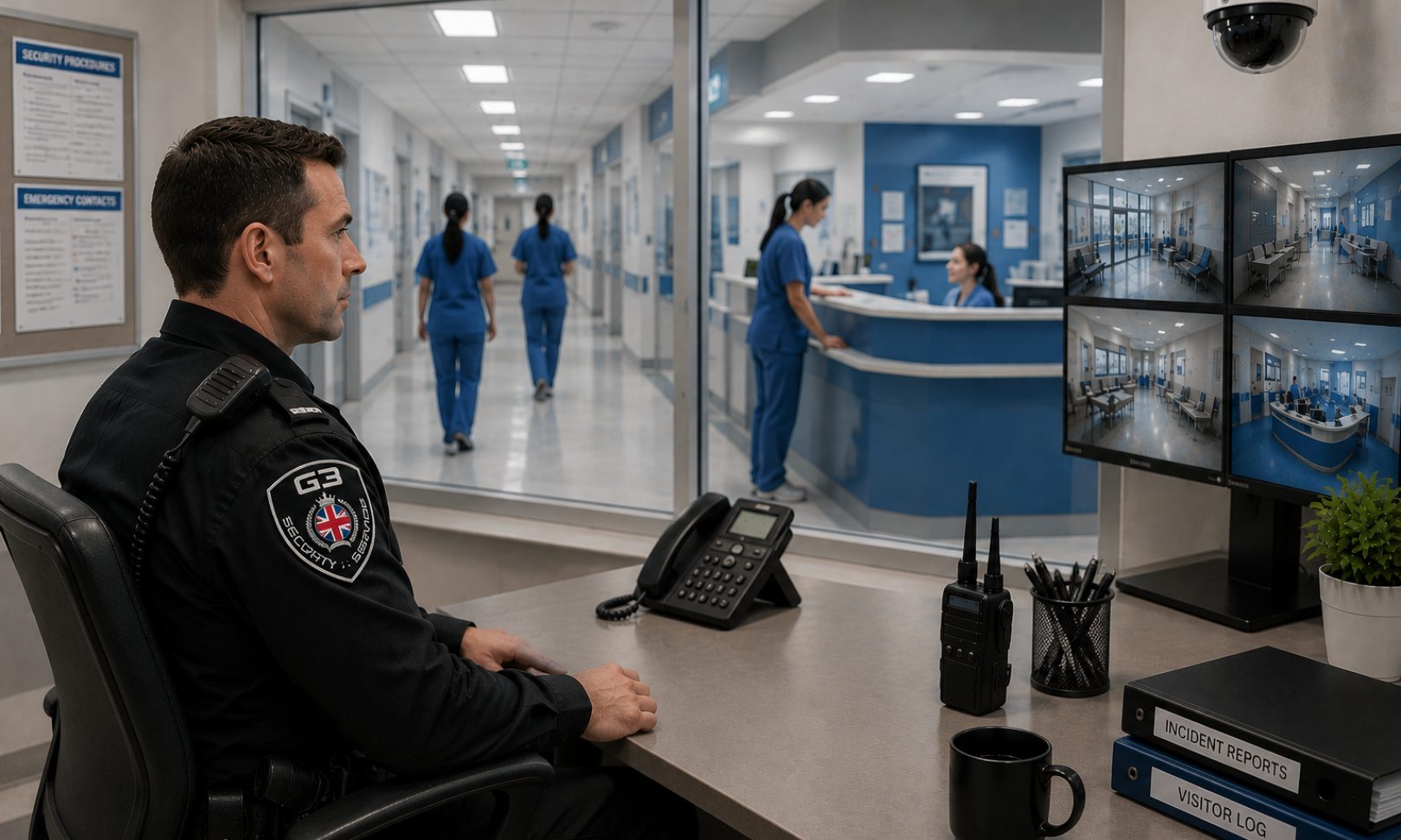
Well-placed CCTV deters crime, supports staff who feel vulnerable, and provides vital evidence when incidents occur. Cover entrances and exits, corridors, waiting areas, car parks, loading bays and the approaches to high-risk departments. Car parks in particular are a common location for theft and confrontation, and deserve proper coverage and lighting.
Modern systems offer real-time monitoring from a central control room, remote viewing and secure footage storage. Whatever you install, make sure cameras are maintained and working, that footage is retained securely and lawfully, and that clear signage informs patients and visitors that recording is taking place, in line with data protection requirements.
Deploy Trained Security Personnel
Technology alone cannot keep a hospital safe. Trained security officers provide the human judgement, presence and rapid response that cameras and locks cannot. In a healthcare setting, their role is far broader than simply standing guard. Good hospital security staff:
- De-escalate tense or violent situations with patients and visitors, using conflict-management skills.
- Support clinical staff, including escorting lone workers and accompanying staff to car parks at night.
- Respond rapidly to alarms, security incidents and medical emergencies.
- Patrol the site to deter crime and spot problems early.
In the UK, use SIA-licensed officers, ideally those with experience or additional training in healthcare environments, where empathy and de-escalation matter as much as physical capability. The best hospital security teams work hand in hand with clinical staff rather than apart from them.
Protect Your High-Risk Areas
Different parts of a hospital carry very different risks, and a one-size-fits-all approach leaves gaps. Identify your highest-risk areas and tailor protection to each:
- Emergency departments (A&E): Often the flashpoint for violence and the arrival of intoxicated or distressed individuals. Consider on-duty security presence, controlled visitor numbers, panic alarms and, where appropriate, weapons screening.
- Maternity and paediatric wards: Newborns and children require protection against the rare but devastating risk of abduction. Electronic infant-tagging systems, restricted-access doors and strict visitor checks are key.
- Pharmacies and controlled-drug storage: Targets for theft and diversion. Use biometric locks, automated dispensing and inventory tracking that logs every movement.
- Mental health units: Require a careful balance of safety and dignity, with measures designed around patient welfare as well as security.
Prepare Emergency Response Procedures
When something goes seriously wrong, your staff need to know exactly what to do, instinctively and immediately. Your plan should set out clear procedures for a range of scenarios, including violent incidents, security threats, missing patients and major emergencies. Essential components include:
- Panic buttons and duress alarms at reception desks, in A&E and at nurses’ stations.
- Lockdown procedures that can secure a ward or wing quickly during a threat.
- Evacuation and evacuation plans that account for patients who cannot move easily.
- Mass notification systems to alert staff across the site via screens, intercoms and mobile alerts.
Crucially, define who is in charge during an incident and how the security team coordinates with clinical staff and the emergency services. Clarity in the moment saves precious time.
Don’t Overlook Cyber Security
A modern hospital security plan must protect data as carefully as it protects people. Hospitals hold vast quantities of confidential patient information and depend on digital systems for everything from records to life-support equipment. That makes them prime targets for cybercriminals, and ransomware attacks on healthcare have caused real disruption to patient care.
Work closely with your IT and information governance teams to ensure strong defences are in place: firewalls and encryption, multi-factor authentication, regular software updates, secure and tested backups, and ongoing staff training to spot phishing attempts. Physical and digital security are two halves of the same plan, and a weakness in one undermines the other.
Build a Culture of Security Awareness
The most sophisticated systems fail if people don’t use them. Security works best when every member of staff understands their part and feels confident acting on it. Provide regular training on conflict de-escalation, lockdown and emergency procedures, infant-protection protocols and cyber awareness.
Make reporting easy and encourage it, staff who feel able to flag suspicious behaviour or near-misses give you early warning of developing problems. Communicate visitor guidelines clearly at entry points, and foster an environment where security is seen as everyone’s responsibility, not just the security team’s.
Test, Review and Improve
A security plan is never truly finished. Threats evolve, the building changes, and procedures that look good on paper can fail in practice. Run regular drills and tabletop exercises so that staff rehearse their responses and you can identify weaknesses before a real incident exposes them.
After any incident or near-miss, hold a structured debrief: what worked, what didn’t, and what should change. Feed those lessons back into your plan so that it improves continuously. The safest hospitals are not the ones that never face threats, they are the ones that prepare, review and adapt relentlessly.
Final Thoughts
Building a hospital security plan means weaving together many strands, risk assessment, access control, surveillance, trained personnel, emergency planning, cyber protection and a strong security culture, into a single, coordinated whole. Each layer supports the others, and together they create an environment where patients can be treated safely and staff can do their jobs without fear.
Above all, hospital security should serve clinical care, not obstruct it. Done well, it protects the people who matter most while remaining almost invisible in day-to-day life. If you are unsure where to begin, a professional security assessment from a provider experienced in healthcare settings can help you identify your priorities and build a plan that is proportionate, compliant and genuinely effective.