
Security plays a central role in protecting businesses, staff, visitors, and assets. When planning a security strategy, one of the key decisions is whether your organisation needs frontline security personnel, non-frontline security staff, or a combination of both. Each role serves a different purpose within a wider security operation, and understanding the difference helps businesses choose the right structure for their environment.
Frontline security officers are the visible presence on-site, dealing directly with people and situations. Non-frontline security staff work behind the scenes, supporting operations through monitoring, coordination, and management tasks. Both roles contribute to maintaining safety, reducing risk, and supporting smooth day-to-day activity.
This guide explains the difference between frontline and non-frontline security roles, their responsibilities, required skills, and how to decide which option suits your business.
What are Frontline Security Roles?
Frontline security roles refer to security personnel who are physically present at a site and interact directly with the public, staff, or visitors. These officers are often the first point of contact in security-related situations and play a visible role in maintaining order.
In the UK, frontline security officers usually hold an SIA licence, which is required for roles such as security guarding, door supervision, and event security. Their presence is common in environments where public interaction, access control, and on-site monitoring are necessary.
Frontline security is widely used in retail stores, construction sites, office buildings, hospitals, hotels, and public events. Their role is not limited to observation; they actively respond to incidents and support site safety procedures.
Frontline officers also act as a deterrent to unwanted behaviour simply by being visible on-site. Their presence contributes to a controlled environment where rules are followed and risks are managed more closely.
Key Responsibilities of Frontline Security
Frontline security officers carry out a wide range of responsibilities depending on the site they are assigned to. Their duties are often dynamic and require constant attention to changing situations.
Common responsibilities include:
- Monitoring entrances and exits
- Checking identification and authorising access
- Patrolling buildings or outdoor areas
- Responding to incidents or disturbances
- Managing crowd movement during busy periods or events
- Writing detailed incident reports
- Assisting staff and visitors with queries
- Supporting emergency procedures such as evacuations
- Observing and reporting suspicious behaviour
In retail environments, frontline guards often focus on loss prevention and customer safety. In construction settings, they may secure the perimeter, prevent unauthorised entry, and protect equipment. In corporate offices, they often manage visitor logs and maintain controlled access.
Their role requires constant awareness of surroundings and the ability to respond calmly under pressure.
What are Non-Frontline Security Roles?
Non-frontline security roles involve responsibilities that take place away from direct public interaction. These positions focus on planning, monitoring, coordination, and management within a security operation.
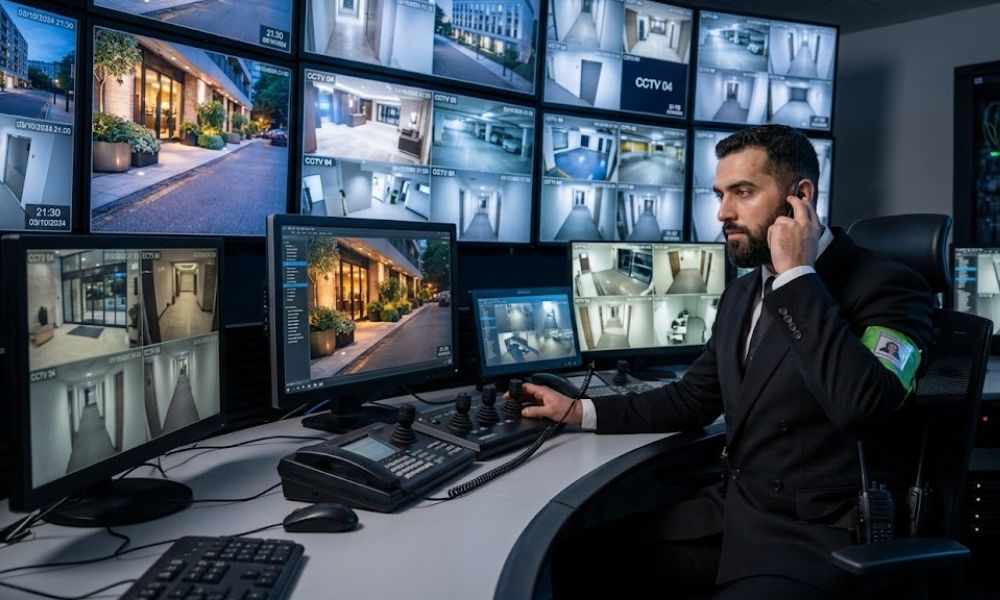
Non-frontline staff may work in control rooms, security offices, or remote monitoring centres. They support frontline teams by analysing information, managing systems, and coordinating responses when needed.
These roles are essential in larger security operations where multiple sites or systems need supervision. While they may not be physically visible to the public, their contribution is critical to overall security performance.
Non-frontline roles are often found in CCTV monitoring centres, security management teams, and operational support units.
Key Responsibilities of Non-Frontline Security
Non-frontline security staff handle technical, administrative, and supervisory tasks that support on-site operations.
Common responsibilities include:
- Monitoring CCTV systems and surveillance feeds
- Reviewing recorded footage when incidents occur
- Coordinating response teams during emergencies
- Managing communication between security teams
- Scheduling and deployment of security staff
- Writing reports and maintaining security records
- Tracking access control systems and alarms
- Analysing security risks and site vulnerabilities
- Supporting compliance with security procedures
For example, a control room operator may monitor multiple CCTV cameras across a large site and alert frontline officers if suspicious activity is detected. A security supervisor may manage shift planning and coordinate responses across several locations.
These roles require strong attention to detail and the ability to process information quickly and accurately.
Skills and Qualifications for Frontline Security
Frontline security officers need a combination of practical skills and formal training to perform their duties effectively.
Key skills include:
- Strong observation and awareness
- Clear communication skills
- Conflict management abilities
- Physical fitness for patrol and response duties
- Decision-making under pressure
- Customer service approach when dealing with the public
- Basic reporting and documentation skills
Most frontline roles require an SIA licence, which involves completing approved training in areas such as emergency procedures, health and safety, and conflict resolution. Depending on the role, additional training such as first aid or door supervision may also be required.
Frontline officers must be able to remain calm in challenging situations and handle incidents professionally without escalating conflict.
Skills and Qualifications for Non-Frontline Security
Non-frontline security roles focus more on analytical and organisational skills rather than physical presence.
Key skills include:
- Attention to detail
- Strong communication and coordination abilities
- Technical knowledge of CCTV and security systems
- Ability to analyse security data and reports
- Problem-solving skills
- Understanding of risk management procedures
- Record keeping and reporting accuracy
- Time management and multitasking
While some non-frontline positions also require an SIA licence, particularly CCTV monitoring roles, others may focus more on experience in security operations or technical systems.
These roles often require familiarity with software systems, alarm monitoring tools, and communication platforms used in security operations.
Which Security Role is Right for You?
Choosing between frontline and non-frontline security roles depends on your business structure, environment, and level of risk.
Frontline security is often the right choice when:
- There is regular public access to your site
- Physical presence is needed to manage safety
- You require on-site response to incidents
- Access control and visitor management are important
- Theft, vandalism, or disruption risks are higher
Non-frontline security is suitable when:
- Multiple sites need central monitoring
- CCTV surveillance plays a major role
- Coordination of security teams is required
- Data analysis and reporting are important
- You operate large or complex security systems
In many cases, businesses benefit from combining both roles. Frontline officers handle on-site situations, while non-frontline staff monitor systems and coordinate responses. This layered structure creates stronger overall coverage.
For example, a retail chain may use frontline guards in stores while a central control room monitors CCTV across all locations. A construction company may rely on site guards during working hours and off-site monitoring during nights.
The right balance depends on operational needs, risk level, and budget considerations.
The Importance of Combining Both Roles
Many modern security operations use a professional approach that includes both frontline and non-frontline personnel. This structure allows businesses to respond quickly to incidents while maintaining constant oversight.
Frontline officers provide physical presence and direct interaction, while non-frontline teams handle monitoring and coordination. Together, they create a connected security system that covers both prevention and response.
This combination is especially useful for:
- Large commercial sites
- Shopping centres
- Industrial facilities
- Public events
- Transport hubs
- Corporate campuses
With both roles working together, security operations become more structured and better organised across different levels.
Conclusion
Frontline and non-frontline security roles both play important parts in protecting businesses and managing risk. Frontline officers provide visible protection, direct interaction, and on-site response, while non-frontline staff support operations through monitoring, coordination, and system management.
Understanding the difference between these roles helps businesses choose the right security structure based on their environment and operational needs. Some organisations may rely heavily on frontline presence, while others depend more on non-frontline monitoring systems. Many benefit from a combination of both.
A well-planned security approach considers site risks, public access, and operational complexity. By aligning the right roles with the right responsibilities, businesses can maintain safer environments, improve incident response, and support smooth daily operations.