
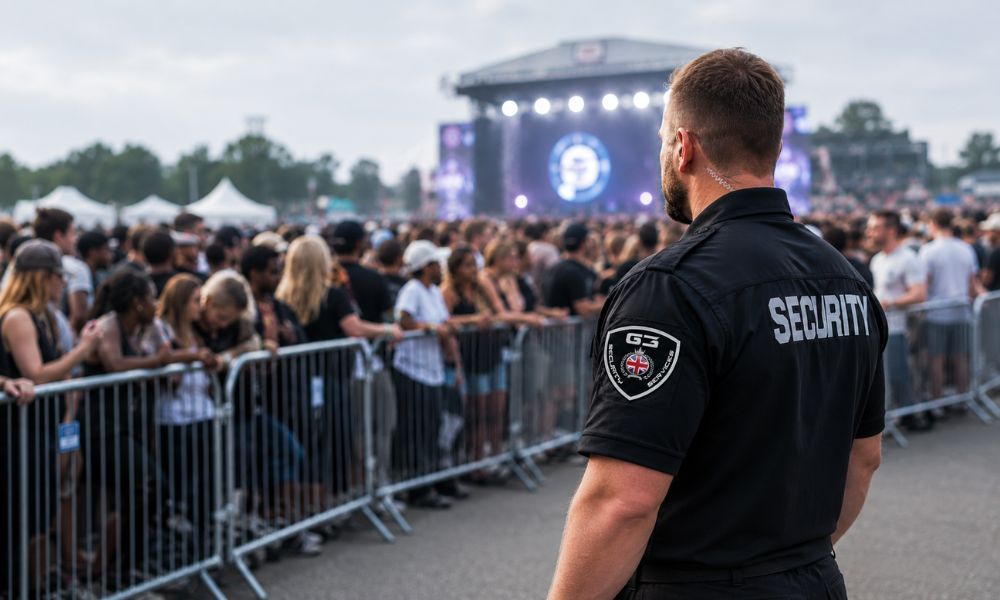
Where large gatherings, events and public assemblies are common, the function of security guards in crowd control has grown increasingly vital. Whether at concerts, sporting events, shopping centres, political rallies or cultural festivals, trained security personnel are essential to maintain calm, direct movement, and uphold safety protocols. Crowd control is not simply about authority, it is about understanding human behaviour, anticipating problems before they arise, and applying structured strategies that protect both the public and the event environment.
This blog explores the role of security guards in managing crowd control, the skills required, operational methods, legal and ethical considerations.
Why Crowd Control Matters
Crowd control is about more than managing large numbers of people. It relates to public safety, risk management, conflict reduction, and structured movement. Poorly managed crowds can lead to panic, physical injuries, property damage and legal repercussions for organisers. Security guards act as the frontline presence whose behaviour shapes the experience of attendees and influences the atmosphere of the entire event.
Large gatherings present unique challenges, people are often excited, impatient or stressed due to long waits, tight spaces, or environmental factors such as heat or noise. Security guards trained in crowd control provide visible support that people recognise and trust. Their presence can reduce confusion, guide movement and decrease the likelihood of confrontations.
Understanding Crowd Psychology
At the heart of crowd control is an understanding of how groups behave. Human psychology in a crowd differs significantly from individual behaviour. People in a crowd may feel anonymous, which can lead to heightened emotions and reduced self‑restraint. Security guards trained in crowd dynamics recognise these patterns and adapt their approach accordingly.
Key principles of crowd psychology that security guards should understand include:
- Social Identity Theory: Individuals often adopt the mindset of the group, leading to collective behaviour distinct from personal behaviour.
- Emotional Contagion: Emotions can spread rapidly across a crowd, one person’s agitation can influence many.
- Density Effects: When personal space is reduced, stress increases and decision‑making can suffer.
Security guards use this knowledge to position themselves strategically, communicate effectively, and reduce situations that might trigger panic or confrontation.
Training and Skills Required for Crowd Control
Security guards working in crowd environments require specialised training and a broad skill set. Crowd control is not intuitive; it is a learned discipline that combines physical readiness with soft skills.
Communication Skills
One of the strongest tools a security guard has is clear communication. Effective communication reduces misunderstandings, redirects attention, and supports orderly movement. Security guards trained in crowd communication speak confidently, use clear instructions, and adopt a calm tone even under pressure.
Situational Awareness
Situational awareness is the ability to perceive, interpret, and project possible developments within the environment. Guards constantly scan for irregularities, shifts in body language, sudden noises, or new bottlenecks in a crowd. They recognise early signs of agitation and act in time to manage it.
Conflict Management
Conflict management is distinct from fighting or confrontation. It involves de‑escalating rising tension, listening actively, and applying non‑violent strategies to calm individuals or groups. Guards with conflict management training know when to intervene directly, when to seek assistance, and when to separate individuals to prevent escalation.
Physical Readiness
While crowd control is largely about psychology and communication, physical readiness matters in ensuring safety. Security guards should meet fitness standards appropriate to event size and location. Physical skills such as controlled restraint (where legal), movement‑guiding positioning, and use of non‑harmful barriers are all part of structured crowd control techniques.
Pre‑Event Planning: The Foundation of Crowd Control
The day of an event is not where crowd control starts. it begins in the planning stages. Professional security teams collaborate with event organisers, venue managers, local authorities and even emergency services before crowds arrive.
Risk Assessment
A thorough risk assessment identifies potential sources of conflict, high‑density zones, emergency access points, and areas where crowd flow may create bottlenecks. Security guards actively participate in mapping the event space, paying particular attention to entry and exit points, stages or focal areas, viewing platform slopes, and any obstructions such as pillars or merchandise tables. This predictive mapping enables guards to position themselves strategically, allowing them to manage the crowd smoothly and respond to emerging situations in a timely manner.
Communication Systems
Pre‑event planning also addresses communication technology. Guards working in large crowds use radios, designated signal systems and message protocols to coordinate actions. Having reliable communication reduces response times and clarifies instructions during high‑pressure moments.
Briefing and Role Allocation
All security personnel should receive detailed briefings including crowd size estimates, expected movements, shift assignments, incident reporting procedures and emergency response plans. Clear role allocation prevents confusion and promotes a cohesive team response on the ground.
On‑Site Roles and Responsibilities
When the event begins and crowds gather, security guards move from planning to real‑time application. Their roles include:
Monitoring Crowd Movement
Security guards observe how people move through the venue and identify patterns that may lead to congestion. They watch for queues that are too close, areas where people are lingering that should be moving, or sudden changes in direction that may indicate confusion or distress.
Guiding Attendees
Verbal guidance, hand signals, and body positioning all help direct the flow of people. Guards keep pedestrian traffic moving smoothly along intended pathways, reduce back‑ups and limit contact between opposing flows, particularly in high‑traffic zones.
Managing Access Points
Entrances and exits are high‑risk areas in any crowded setting. Security guards at these points verify tickets or passes, control the number of people entering each minute, and adjust speed based on crowd size to prevent surges that could injure people.
Responding to Incidents
Incidents can range from someone feeling unwell to a heated verbal dispute. Security guards follow procedural steps that include assessing the severity, calling for additional support if needed, and applying conflict‑reducing techniques. Importantly, guards do not act in a way that escalates the situation.
Technology’s Role in Crowd Control
Modern crowd control does not rely solely on human capability, technology plays a supportive role. Surveillance cameras help monitor large areas, and real‑time data analysis assists commanders in making informed decisions.
Security operations centres use analytics dashboards that can process video feeds and identify areas of concern. These systems might flag unusual crowd density, sudden movements or prolonged stationary clusters. Guards receive alerts through handheld devices, providing context‑sensitive information that allows timely intervention.
Legal and Ethical Considerations
Security guards must operate within the law and respect human rights. Crowd control includes balancing firmness with fairness. Conduct that could be seen as discriminatory, overly forceful or demeaning undermines public trust and exposes organisers to legal liabilities.
Guidelines for legal and ethical practice include:
- Respecting personal space and dignity
- Using only lawful methods of movement guidance
- Maintaining records of incidents to support transparency
- Escalating to law enforcement when threats exceed their authority
Security guards who respect legal boundaries cultivate a professional image and preserve the safety of attendees.
Post‑Event Review and Improvement
Once the crowd disperses and the event concludes, security teams conduct a debrief to review performance. This includes:
- Incident reports
- Crowd flow data
- Staff reflections
- Stakeholder feedback
These reviews allow teams to identify patterns that worked well, practices that need adjustment, and new risks that might appear in future events. Continuous learning is central to crowd control excellence.
Conclusion
The role of security guards in managing crowd control is complex, demanding, and fundamentally people‑centred. Security personnel are trained to observe, communicate, and act with precision to keep large gatherings orderly. Crowd control is achieved through preparation, understanding group behaviour, strategic positioning and thoughtful responsiveness. What remains constant, however, is the human element, the ability of security guards to interact with people in ways that promote respect, direction and calm.
In a world where public events draw increasingly large numbers of attendees, the ongoing development of crowd control techniques and professional training remains essential. Ultimately, the success of crowd management lies in a blend of skill, presence and responsible action by security professionals committed to public safety.