
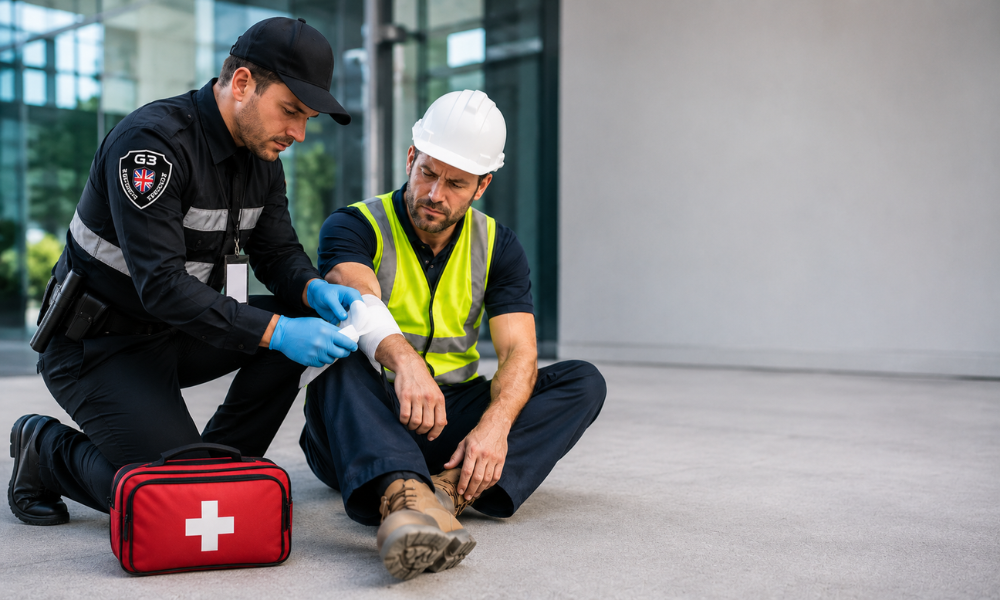
When people think about what a security guard does, they usually picture watching for trouble, controlling access and deterring crime. But some of the most important moments in a guard’s career have nothing to do with stopping a criminal, they involve helping someone who has collapsed, started choking, or been injured. Because security officers are so often the first people on the scene, first aid training can turn an ordinary guard into a genuine lifesaver. Here’s why it should be considered essential, not optional, for everyone working in the industry.
Guards are Usually First on the Scene
In an emergency, the few minutes before an ambulance arrives are critical, and during those minutes, it’s frequently a security officer who is closest to the casualty. Whether it’s a shopper having a heart attack, a guest fainting at an event, or a visitor suffering a severe allergic reaction, the guard is often the only person present with both the position and the authority to act.
A trained officer knows how to quickly assess the situation, take control, and provide care that can stabilise someone until professional help takes over. An untrained one, however well-meaning, may freeze, act incorrectly, or waste precious time. In situations where every second counts, that difference can be life or death.
The Emergencies Guards are Most Likely to Face
First aid training prepares officers for the kinds of incidents that genuinely occur on the job, including:
- Cardiac Arrest: recognising the warning signs and starting CPR immediately to keep blood and oxygen moving to the brain and vital organs until paramedics arrive.
- Choking: clearing a blocked airway using back blows and abdominal thrusts when someone can’t breathe.
- Severe Bleeding: Applying pressure and dressings correctly to control blood loss and prevent shock.
- Allergic Reactions: Helping someone use an auto-injector (such as an EpiPen) during anaphylaxis.
- Fainting, Seizures and Diabetic Episodes: Knowing how to keep a person safe and comfortable until they recover or help arrives.
- Injuries from Accidents or Incidents: Supporting fractures, treating wounds, and reassuring the casualty.
Knowing how to respond to each of these calmly and correctly is exactly what separates a trained officer from a bystander.
Speed and Confidence Under Pressure
A medical emergency is frightening and chaotic. Panic spreads quickly, and untrained people often hesitate because they’re afraid of doing the wrong thing. First aid training builds the muscle memory and confidence that allow a guard to step in without freezing.
That composure matters in two ways. First, it means the casualty receives prompt, correct care. Second, a calm and capable officer steadies everyone else nearby, preventing the panic that can make a bad situation worse. Decisiveness under pressure is a skill, and first aid training is how it’s developed.
Protecting Vulnerable People and High-profile Clients
Security guards regularly work in places full of people who may need help, shopping centres, hotels, transport hubs, events and venues. Many of those people, tourists unfamiliar with the area, elderly visitors, or guests in unfamiliar surroundings, are more vulnerable to mishaps and slower to get help on their own.
For close protection and VIP work, the stakes are higher still. High-profile clients often operate in demanding, high-stress environments where sudden health issues can arise, and where a discreet, capable response is expected. A first aid–trained officer can stabilise a client quietly and professionally, ensuring a minor episode never becomes a crisis.
Stopping Small Problems Becoming Big Ones
Many medical situations start small and escalate only because no one intervenes early. Someone feeling faint might simply need to sit down and take on fluids, but left unnoticed, they could collapse and suffer a serious injury. A guard trained in first aid can spot the early warning signs and act before a manageable issue turns into an emergency. This proactive awareness is one of the most underrated benefits of training.
Working Effectively With the Emergency Services
First aid doesn’t end when the paramedics arrive, and a trained guard knows that handing over well is part of the job. They can give responders a clear, useful briefing, what happened, what symptoms they observed, what care they provided, and any other relevant details. This handover saves time and helps medical professionals make faster, better-informed decisions. A guard who can communicate clearly in those moments becomes a genuine asset to the wider emergency response.
Professional Standards and Reputation
In the UK security industry, professionalism is everything, and first aid capability is increasingly seen as a mark of a serious, well-run operation. For security companies, ensuring officers are first aid trained:
- Demonstrates a real commitment to safety and duty of care
- Helps meet client expectations and contractual requirements
- Builds trust with the public and with clients
- Strengthens the firm’s reputation as a responsible, capable provider
Clients feel reassured knowing the people protecting them can handle a medical emergency as competently as a security one. That confidence is good for business as well as for safety.
Building Trust and Peace of Mind
Ultimately, first aid training changes how people feel about the security presence around them. When the public and clients know that the guards on duty are equipped to help in a health emergency, not just to watch for threats, they feel genuinely safer. That sense of reassurance is one of the most valuable things a security service can offer, and it flows directly from the competence and readiness of its officers.
The bottom line
A security guard’s job is to keep people safe, and safety doesn’t stop at preventing crime. Medical emergencies happen without warning, and guards are uniquely placed to make a life-saving difference in the crucial minutes before professional help arrives. First aid training gives them the skills, the speed and the confidence to do exactly that, while raising professional standards and building trust at the same time.