
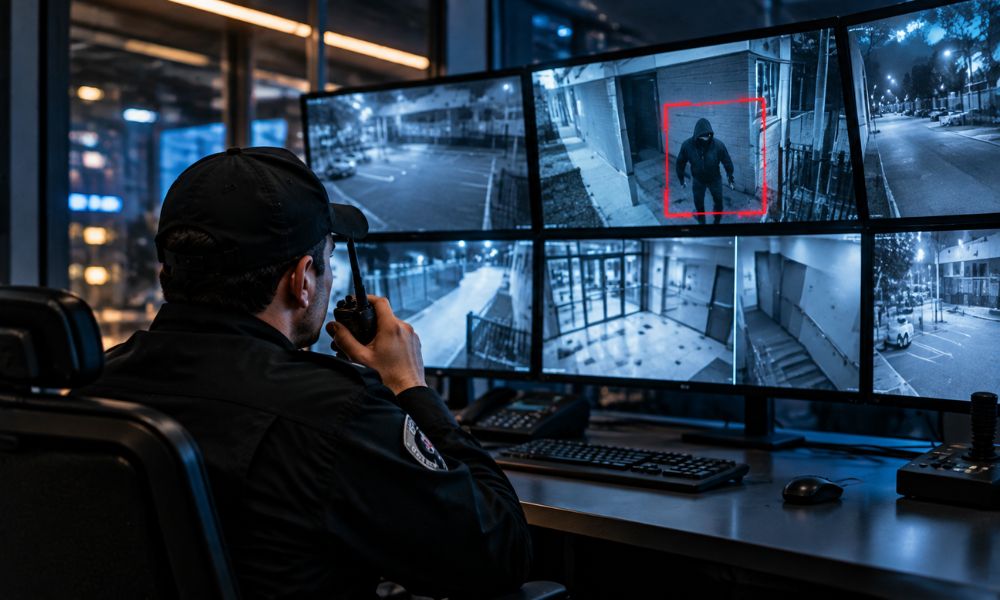
CCTV can help businesses monitor their premises and identify unusual activity, but detecting something suspicious is only the first step. What happens next depends on the type of activity, where it is happening and whether there is a real security risk.
A monitored CCTV system can help trained operators to review what is happening, assess the situation and take the appropriate next step. This could involve contacting someone on site, alerting a mobile patrol, contacting the emergency services or continuing to monitor the situation.
Understanding the process can help business owners see how CCTV monitoring fits into a wider security plan.
What Counts as Suspicious Activity on CCTV?
Suspicious activity does not always mean that a crime is taking place. CCTV operators may notice behaviour or circumstances that are unusual for a particular property.
Examples can include:
- Someone entering a restricted area
- A person trying to access a building after closing
- Someone repeatedly checking doors or windows
- Unusual activity around vehicles
- People entering an empty property
- Someone attempting to climb a fence
- Unusual movement around storage areas
- Damage to doors, gates or other access points
- People remaining around a property without an obvious reason
The operator needs to consider the wider situation before deciding what action is appropriate.
Step 1: The CCTV Operator Reviews the Footage
When an alert is received, the first step is to check what is actually happening. An operator may look at the relevant camera and nearby cameras to understand the situation. They may check:
- Where the person is
- What they are doing
- How many people are present
- Whether they have entered a restricted area
- Whether there are signs of forced entry
- Whether employees or authorised visitors are nearby
- Whether the activity matches normal site operations
This helps separate a genuine security concern from normal activity.
Step 2: The Situation Is Assessed
After reviewing the footage, the CCTV operator assesses the level of concern. Not every alert requires the same response. An operator may continue monitoring if the activity appears harmless, while more concerning behaviour may require immediate action. The response can depend on factors such as:
- The type of property
- Time of day
- Location of the activity
- Number of people involved
- Signs of forced entry
- Previous incidents
- Whether anyone is at risk
- The client’s agreed security procedures
A clear response process helps avoid unnecessary action while allowing genuine incidents to be dealt with quickly.
Step 3: The Operator Contacts the Appropriate Person
If further action is needed, the CCTV operator may contact a designated person according to the agreed response procedure. Depending on the service, this could include:
- A site manager
- A business owner
- A key holder
- A security guard
- A mobile patrol team
- Emergency services
The exact process should be agreed when the CCTV monitoring service is set up.
Step 4: A Mobile Patrol May Be Sent to the Site
For businesses using both CCTV monitoring and mobile patrols, a suspicious activity alert can result in a patrol officer being sent to the property.
The patrol officer can check the site from the outside or follow the agreed instructions for the premises. They may look for signs such as:
- Damaged doors
- Open gates
- Broken windows
- Unauthorised vehicles
- Signs of attempted entry
- Damage to fencing
A patrol officer can then report their findings and follow the next stage of the agreed response plan. Combining CCTV monitoring with mobile patrols can give businesses an additional layer of protection, particularly when their premises are unattended.
Step 5: Emergency Services May Be Contacted
If CCTV detects activity that may indicate a serious security issue, the operator will assess the situation and follow the agreed response procedure. The priority is to provide the right information without putting anyone at unnecessary risk.
This may involve:
- Contacting the appropriate emergency service
- Informing the key holder or responsible person
- Providing details about what the CCTV cameras have captured
- Requesting a mobile patrol to attend the property, where applicable
- Continuing to monitor the situation
For example, if CCTV shows an apparent break-in while a business is closed, the operator can provide relevant information to those responding to the incident. The exact response will depend on the circumstances and the procedures agreed with the client.
Step 6: The Incident Is Recorded
After the situation has been dealt with, the incident should be recorded. An incident record may include:
- Date and time
- Location
- Camera involved
- Description of the activity
- Actions taken
- People contacted
- Patrol findings
- Emergency service involvement, where applicable
- Outcome of the incident
Accurate records can help businesses understand what happened and identify security issues that may need attention.
For example, if CCTV repeatedly detects people near the same access point, the business may decide to review its lighting, fencing, access control or patrol arrangements.
What if the Activity Turns Out to Be Harmless?
Not every suspicious-looking situation is a security incident. A CCTV operator may discover that the person is an employee working late, a contractor with authorised access or someone carrying out legitimate work.
In these cases, the operator can record the event according to the agreed procedure and continue monitoring where appropriate.
This is one reason why trained monitoring staff need to assess the situation rather than immediately treating every alert as a confirmed security breach.
What Happens If CCTV Detects a Break-In?
A suspected break-in requires a more serious response. The CCTV operator may:
- Review the relevant camera footage.
- Check other cameras around the property.
- Assess whether people have entered the building.
- Follow the agreed alarm response procedure.
- Contact the appropriate key holder or security team.
- Arrange a mobile patrol response where applicable.
- Contact emergency services where appropriate.
- Continue monitoring the situation.
- Record the incident and actions taken.
The exact process will depend on the property’s security arrangements and the nature of the incident.
How Businesses Can Improve Their CCTV Response
Having cameras installed is only part of a CCTV security plan. Businesses should also think about what happens when a camera identifies a potential problem.
Useful steps include:
- Identify which areas need CCTV coverage
- Make sure cameras cover important access points
- Use suitable lighting around the property
- Set clear alarm and escalation procedures
- Keep key holder information up to date
- Consider CCTV monitoring outside business hours
- Combine CCTV with mobile patrols where appropriate
- Review incidents and recurring security issues
- Keep security procedures clear for staff
Regularly reviewing the system can also help identify blind spots or areas where additional protection may be needed.
CCTV Monitoring and Mobile Patrols Working Together
CCTV monitoring and mobile patrols can perform different but complementary roles. CCTV monitoring allows activity to be observed remotely, while mobile patrol officers can attend the property when a physical check is required.
For example, CCTV may detect movement around a warehouse after closing time. The monitoring operator can assess the footage and, where included in the agreed service, request a mobile patrol to attend. The patrol officer can then check the premises and report what they find.
This approach can be particularly useful for large sites, warehouses, construction sites, commercial buildings and vacant properties.
Why a Clear CCTV Response Procedure Matters
A CCTV system is more useful when there is a clear plan for dealing with alerts. Without an agreed response procedure, staff may be unsure who should be contacted or what action should be taken when suspicious activity is detected.
A good procedure should explain:
- Who receives alerts
- Who monitors the cameras
- When the key holder should be contacted
- When a mobile patrol should attend
- When emergency services should be contacted
- How incidents should be recorded
- Who receives the incident report
These arrangements should be reviewed whenever there are changes to the property, staff, access arrangements or security requirements.
How Security Services Can Help With CCTV Monitoring
At G3 Security, we can help businesses build a practical security response around their CCTV systems. Our services can work alongside CCTV monitoring and mobile patrols to help businesses respond when suspicious activity is detected.
Our team can help identify areas that may need additional security coverage and discuss suitable arrangements for your property. Where required, CCTV alerts can form part of a wider response involving security personnel and mobile patrols.
Whether you manage a construction site, warehouse, commercial property or vacant building, G3 Security can discuss your requirements and provide a security solution based on your site and operating hours.
Conclusion
When CCTV detects suspicious activity, the response should begin with assessing what is happening rather than assuming a crime has occurred. A trained operator can review the footage, assess the situation and follow the agreed response procedure.
Depending on the circumstances, this may involve contacting a key holder, sending a mobile patrol or contacting the emergency services. Recording the incident afterwards can also help businesses identify recurring risks and improve their security arrangements.
For businesses that need more than cameras alone, combining CCTV monitoring with mobile patrols and other security services can provide a wider approach to protecting their premises.