
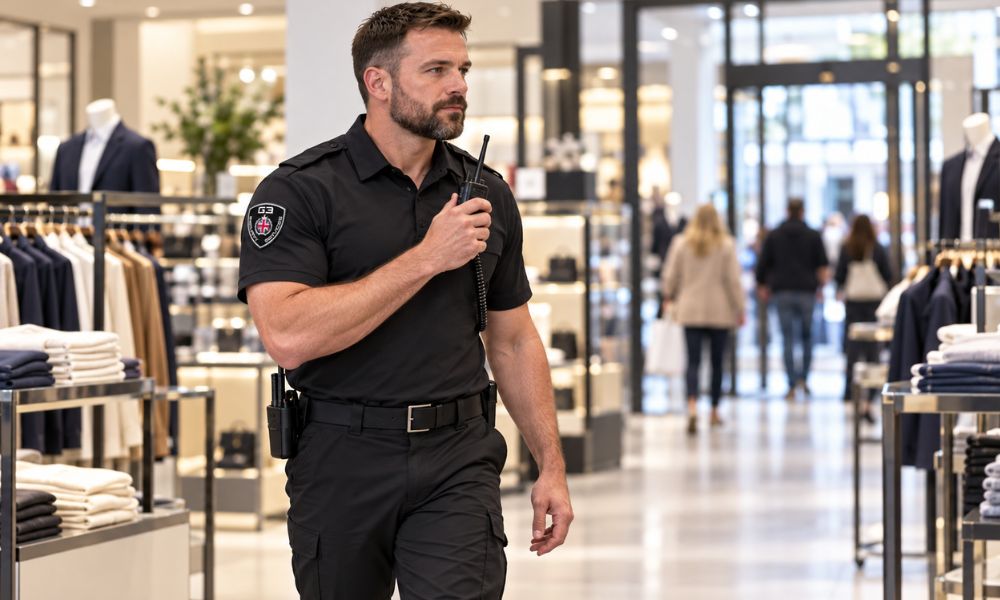
Shoplifting puts retail staff in a difficult position. A guard may see someone conceal an item or walk past the tills without paying, but deciding how to respond involves more than recovering stock. The evidence, the risk to people and the guard’s legal authority all matter.
Yes, security guards can stop shoplifters in certain circumstances. They can approach someone and ask questions, and a lawful citizen’s arrest may be possible. However, their uniform or SIA licence does not give them police powers.
What Does “Stopping a Shoplifter” Mean?
Stopping someone can describe several different actions. A guard might ask a customer to pause while a payment is checked, request permission to inspect a bag, or prevent someone from leaving through a lawful arrest.
These actions should not be treated as interchangeable. Agreeing to answer a question is different from being detained. Ordinary security operatives have no special powers beyond those available to other citizens.
Understanding this distinction helps explain why a guard may speak to a shopper but still lack grounds to physically hold them.
What Counts as Shoplifting?
Shoplifting is the theft of goods from a shop. It occurs when someone dishonestly takes items belonging to the retailer with the intention of keeping them permanently. Whether an incident amounts to theft depends on the circumstances, including the person’s actions and intentions.
Suspicious behaviour does not always mean a customer is stealing. Someone who places an item in a personal bag may still intend to pay for it. Security guards should consider the circumstances before drawing conclusions.
Theft does not necessarily begin when someone leaves the shop. Although a store may require guards to observe certain actions before approaching a customer, these internal procedures do not determine whether theft has legally occurred.
How Do Security Guards Stop Shoplifters?
Security guards help stop shoplifting by monitoring the store, assessing suspicious activity and approaching people when there is a clear concern. Their visible presence can also discourage theft before it happens.
The response depends on what the guard has observed and the risks involved. Some incidents can be resolved through conversation, while others may require police assistance. Guards must follow store procedures and act within their legal authority.
Monitor the Shop Floor and CCTV
Security guards patrol the shop floor and watch for activity that may suggest theft, such as concealing goods or passing the checkout with unpaid items. They consider the sequence of events rather than treating one suspicious action as proof.
CCTV can help guards follow a person’s movements and check what happened. Communication with store employees and other security staff can provide further information before an approach is made.
Assess the Situation Before Approaching
Before approaching someone, a guard should assess the available information and consider possible innocent explanations. A customer may intend to pay for an item placed in a bag, or an alarm may sound because a security tag was left attached.
Checking observations, payment information or CCTV can help prevent a mistaken accusation. Store procedures guide this process, but they do not give guards additional powers to arrest or detain customers.
Approach the Suspect Calmly
A guard may approach the person, identify themselves and explain the concern about an apparently unpaid item. Using neutral language gives the customer an opportunity to explain without creating unnecessary embarrassment or tension.
If the issue involves an accidental missed payment, staff may help resolve it at the checkout. The guard should maintain a safe distance and remember that asking someone to stop does not automatically create a right to prevent them from leaving.
Use Communication to Reduce Conflict
A calm tone and clear explanation can help prevent an incident from becoming confrontational. Guards should listen to the person’s response and avoid threats, insults or aggressive behaviour that could make the situation worse.
If the person becomes threatening, the guard should reassess the risk and request assistance. Protecting staff and customers takes priority over recovering goods, particularly where intervention could lead to violence.
Make a Citizen’s Arrest When Legally Justified
In England security guards may make a citizen’s arrest when the legal conditions are met. These include grounds relating to the offence, a recognised reason why arrest is necessary and circumstances where a police officer cannot reasonably make the arrest instead.
Guards cannot hold someone simply to investigate a vague suspicion. During a lawful arrest, the person must be told that they are under arrest and why, as soon as reasonably practicable. Any force used must be reasonable in the circumstances.
Contact the Police and Preserve Evidence
When police assistance is needed, guards should explain what happened and provide accurate information about the people and goods involved. Relevant CCTV footage, witness accounts and a clear incident report can support the investigation.
If the suspect leaves, preserving evidence still allows the incident to be reported. Guards should assess the risks before pursuing anyone, as a chase could endanger shoppers, staff or members of the public.
Do Security Guards Have Police Powers?
An SIA licence does not turn a guard into a police officer. Their authority to arrest a suspected shoplifter generally comes from the citizen’s arrest rules, rather than their job title.
This matters when considering searches, detention and force. A shop’s internal policy cannot create police powers or override the law.
A guard’s responsibilities may also be narrower than what the law potentially permits. An employer may instruct officers to observe, report and preserve evidence rather than make physical interventions.
What Evidence Should a Guard Consider?
A sound response starts with accurate observations. A guard should distinguish what they directly saw from what someone else reported or what they inferred. Useful details might include which item was taken, where the person went, whether payment was checked and whether the guard lost sight of them. Missing information should be recorded honestly.
Can Security Guards Use Force Against Shoplifters?
Section 3 of the Criminal Law Act 1967 permits reasonable force to prevent crime or carry out or assist a lawful arrest. Any force must be necessary in the circumstances and proportionate to the threat. This is a limit, not a routine instruction to use force. Physical intervention needs its own justification; making an accusation does not establish that justification.
A calm conversation and a physical struggle present different circumstances. Force must not become punishment or retaliation. Where circumstances change, the justification for continuing an intervention also needs reassessment.
Can a Security Guard Search a Customer’s Bag?
An ordinary retail security search is generally based on consent. The SIA’s published search training requirements include explaining the search policy and obtaining permission before searching a person or their possessions.
A request to inspect a bag should therefore be distinguished from police stop-and-search powers. Refusing a voluntary search does not, by itself, establish that theft has occurred or satisfy the conditions for arrest.
Where an offence is reasonably suspected, the guard must assess the relevant arrest conditions separately. A citizen’s arrest does not automatically provide general police search powers.
Should Security Guards Chase Shoplifters?
A chase is not automatically justified by suspected theft. The guard should consider traffic, nearby customers, visibility, available support and the possibility of violence.
For example, following someone into a busy road creates a different risk from observing their direction of travel from a safe position. Recovering an item should not be the only consideration.
The appropriate response depends on the law, training and assignment instructions. Police guidance recommends avoiding actions that provoke an offender and reaching safety where possible.
How Can Retailers Support Better Security Decisions?
Clear instructions help guards understand their role before an incident occurs. A useful briefing should explain who contacts police, who preserves footage, when management becomes involved and what intervention the assignment permits.
Training also needs to suit the location. Licence-linked training sets a minimum standard and may not prepare an operative for every deployment.
Retailers can support better decisions by reviewing incidents, identifying gaps in communication and ensuring officers know how to escalate concerns. The aim is a consistent response that protects people and provides reliable evidence.
How Retail Security Can Help
Retail security plays an important role in preventing shoplifting, protecting staff and customers, and helping stores respond to incidents appropriately. Security guards can monitor shop floors, observe suspicious activity, manage access where required and communicate with store staff when a potential theft occurs. They can also help preserve CCTV footage, record incident details and contact the police when necessary. A clear security plan helps staff understand how to respond to suspected shoplifting while keeping safety and legal responsibilities in mind.
At G3 Security, we provide retail security services tailored to the needs of your business. Our security guards can help monitor retail premises, respond to suspicious activity and support your staff in managing difficult situations. We understand the importance of following agreed procedures, treating customers fairly and acting within the law. Whether you manage a small shop or a larger retail premises, G3 Security can help you put suitable security measures in place to protect your people, property and stock.
Conclusion
Security guards can intervene in shoplifting incidents, and a citizen’s arrest may be lawful when the required conditions are met. Their role does not give them unlimited authority to search, detain or use force.
Effective retail security relies on careful observation, clear communication and decisions that reflect the evidence and risks. Knowing when to intervene, when to seek police support and when to preserve evidence helps protect both the business and the people inside it.