
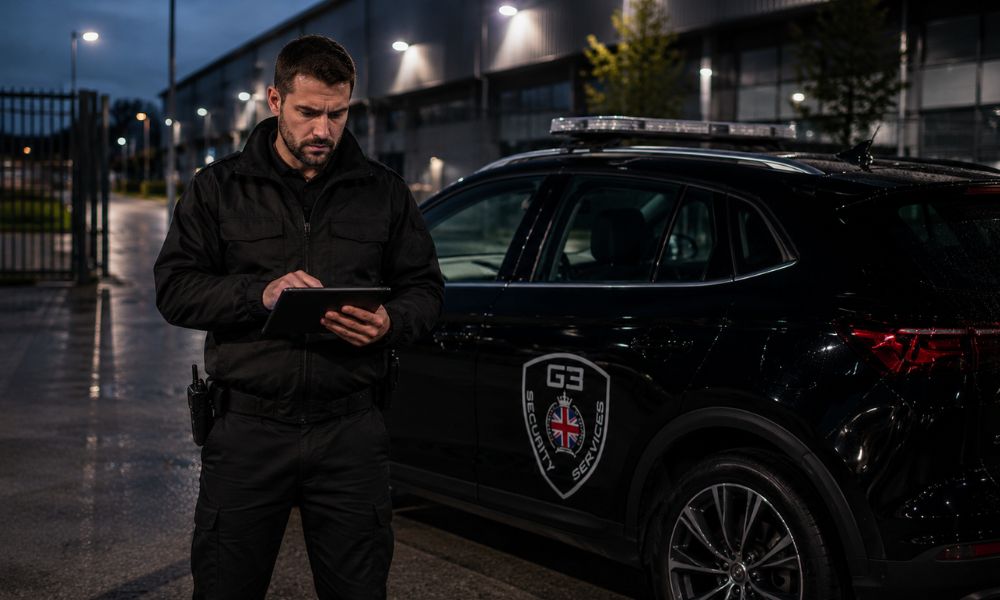
Anyone who’s actually run a patrol service knows the truth, buying a patrol vehicle and putting a guard behind the wheel is the easy part. Managing it well, so that every visit actually adds value instead of becoming a box-ticking drive-by, is where most operations quietly fall short.
This guide walks through what security patrols actually are, the strategies that make them effective, and the management practices that separate a patrol service people trust from one that’s just going through the motions.
What are Security Patrols?
At its core, a security patrol is exactly what it sounds like, a guard or team moving through a site or route to check for problems, deter wrongdoing, and respond if something’s wrong. But that simple description hides a lot of variation. A patrol might mean one officer walking the corridors of an office building at 2am, or it might mean a driver covering fifteen separate sites across a city in a single shift.
What ties all of it together is the same underlying idea, a moving presence is harder to predict, and harder to plan around, than a fixed one. That’s what makes patrols useful in situations where static guarding either isn’t practical or isn’t enough on its own.
Types of Patrols
Foot Patrols
Foot patrols are the traditional image most people have of security, an officer walking a set route through a building, a car park, or a campus. They’re well suited to smaller or more contained sites, places with a lot of pedestrian traffic, or areas where a vehicle simply can’t go, like the interior of a warehouse or the upper floors of an office block.
The advantage of a foot patrol is proximity. An officer on foot notices things a vehicle would drive straight past, a door that’s not quite latched, a smell of smoke, a window left open on an upper floor.
Mobile Patrols
Mobile patrols cover ground that foot patrols can’t. A single vehicle-based officer can realistically check multiple sites in one shift, which makes mobile patrols the more cost-effective option for businesses that don’t need, or can’t justify, a dedicated guard on-site around the clock.
This is usually where the biggest efficiency gains sit: instead of paying for a static guard at every location, a business can share a patrol officer across several properties, scaling coverage up or down depending on risk and budget.
Mobile Patrol Strategies
Not all patrols are run the same way, and the strategy matters as much as the patrol itself.
Active Patrols
Active patrols follow a set schedule, the same route, checked at roughly the same times, every day. The benefit is consistency, every corner of the site gets covered, and nothing gets missed because a route was skipped. The trade-off is predictability, which is why active patrols work best as one layer of a broader strategy rather than the only one.
Random Patrols
Random patrols deliberately avoid a fixed pattern. Visit times, routes, and duration all vary, which means anyone watching a site to find a gap in coverage never gets a reliable answer. This unpredictability is one of the single biggest deterrents in physical security, criminals plan around routine, and random patrols deny them that.
Covert Patrols
Covert patrols take unpredictability a step further by removing visible markers altogether, unmarked vehicles, plain-clothes officers, no uniform presence to announce that security is even on-site. These are typically used where visible security might just push a problem elsewhere rather than stop it, such as investigating suspected internal theft or monitoring a specific ongoing issue without tipping anyone off.
How to Manage an Effective Security Patrol Service
Route Planning and Risk Assessment
A patrol route shouldn’t be an afterthought, it should be built around an honest assessment of where the real risks are. That means identifying entry points, blind spots, high-value storage areas, and any part of the site with a history of incidents, then designing a route that actually covers them rather than just looping the perimeter because that’s the obvious path.
Risk isn’t static, either. A route that made sense a year ago might be missing a new loading bay, an extended building, or a change in how the site is used. Revisiting the risk assessment periodically, not just setting it once and forgetting it, is what keeps a patrol route relevant.
Training
A patrol officer’s value comes almost entirely from judgment, and judgment has to be trained. That includes the practical basics, what to check, how to document it, when to escalate, but also the harder-to-teach skills: staying calm under pressure, de-escalating a confrontation, and knowing the legal limits of what a security officer can and can’t do.
Training isn’t a one-time induction, either. Refreshers, scenario practice, and updates whenever procedures change are what keep a team sharp rather than just qualified on paper.
Performance
If patrols aren’t being measured, they’re essentially running on trust alone, and trust isn’t a management system. Response times, the thoroughness of each visit, the quality of incident reporting, and how consistently routes are actually completed (rather than shortened) all need to be tracked. Without that visibility, it’s impossible to tell a genuinely strong patrol officer from one who’s simply never been caught cutting corners.
Continuous Improvement
The best patrol operations treat every incident, and every near-miss, as information. A break-in that wasn’t caught in time, a blind spot a random patrol happened to expose, a route that took longer than expected: all of it should feed back into how routes, timing, and training get adjusted. A patrol service that looks identical to how it operated two years ago probably isn’t improving; it’s just repeating.
Common Patrol Management Mistakes
A few mistakes show up again and again in patrol operations that underperform:
- Predictable routes and timing, if a patrol arrives at the same spot at the same time every night, it stops being a deterrent and starts being a schedule an intruder can work around.
- No verification of actual presence, assuming a patrol happened because it was scheduled, rather than confirming it actually did.
- Under-resourcing large sites, trying to cover too much ground with too few officers, which turns a patrol into a rushed drive-through instead of a genuine check.
- Treating training as a one-off, qualifying an officer once and never revisiting skills, judgment, or updated procedures again.
- Ignoring the data, collecting logs and reports but never actually reviewing them to spot patterns or improve the service.
Most of these come down to the same root cause: treating patrols as something you set up once, rather than something you actively manage.
Mobile Patrol Performance Monitoring
Managing a patrol well means being able to prove, not just assume, that it happened, and happened properly. Several tools help with that:
- Written logs are the most basic form of accountability, a record of what was checked, what was found, and any action taken. They’re simple, but only useful if they’re actually detailed and actually reviewed.
- GPS location tracking of a mobile device confirms exactly where and when an officer was on-site, removing any doubt about whether a route was completed in full or cut short.
- Photographic evidence adds a layer of proof that goes beyond an officer’s word, a photo of a locked gate, a checked fire exit, or a resolved issue gives clients and managers something concrete to review.
- Check-in calls provide a real-time way to confirm an officer has reached a site and is safe, particularly valuable for lone-working patrols during unsociable hours.
- Technology-integrated proof of presence, such as NFC tags or QR code checkpoints along a route, gives an automatic, tamper-resistant record that an officer physically reached each point on the patrol, harder to fake than a log entry alone.
- Basic guard tour software systems tie all of this together, combining route data, timestamps, and reports into a single dashboard that makes it far easier for managers to spot gaps, review performance, and give clients transparent reporting on exactly what they’re paying for.
Bringing It All Together
Managing mobile security patrols well isn’t about buying the right vehicle or hiring the right uniform, it’s about combining smart route planning, properly trained officers, real performance data, and a willingness to keep adjusting as risks change. Get those pieces working together, and a patrol stops being a routine drive-by and becomes what it’s supposed to be: a genuine, adaptable layer of protection that criminals can’t predict and clients can actually verify.